
Can you name the color of e4 with your eyes closed? In blindfold chess, that single skill separates clarity from confusion. Many players calculate well, but pieces blur and bishops switch colors in their minds. The board dissolves, and confidence fades. Here is the fix. You will improve blindfold with square colors training using simple anchors, patterns, and focused drills. This guide promises a practical, repeatable system that frees brain space for calculation and strategy.
Understanding square color visualization
Square color visualization means knowing whether any square is light or dark without sight. It sounds basic. However, in blindfold chess it becomes your anchor. Every move rests on the color beneath a piece. Bishops stay on one color, pawns capture to the opposite color, and knights always land on the opposite color.
The challenge grows during complex lines. You may recall e4 is light, then lose track after several moves. Suddenly you are unsure if your bishop belongs on f5 or g6.
That uncertainty compounds when several pieces move in your head. Your brain juggles positions, tactics, and threats while the grid fades. One color mistake cascades through the entire calculation. You rebuild the image, and precious time disappears.
Danny Rensch, Chief Chess Officer at Chess.com, captures the mindset: "Brain space is the most valuable thing for me... white on the right, and I changed my knights... I'm just trying to free up brain space as quickly as I can." Automate color recognition, and you free attention for calculation. The answer to a square's color arrives instantly, without conscious effort.
Start with the corners
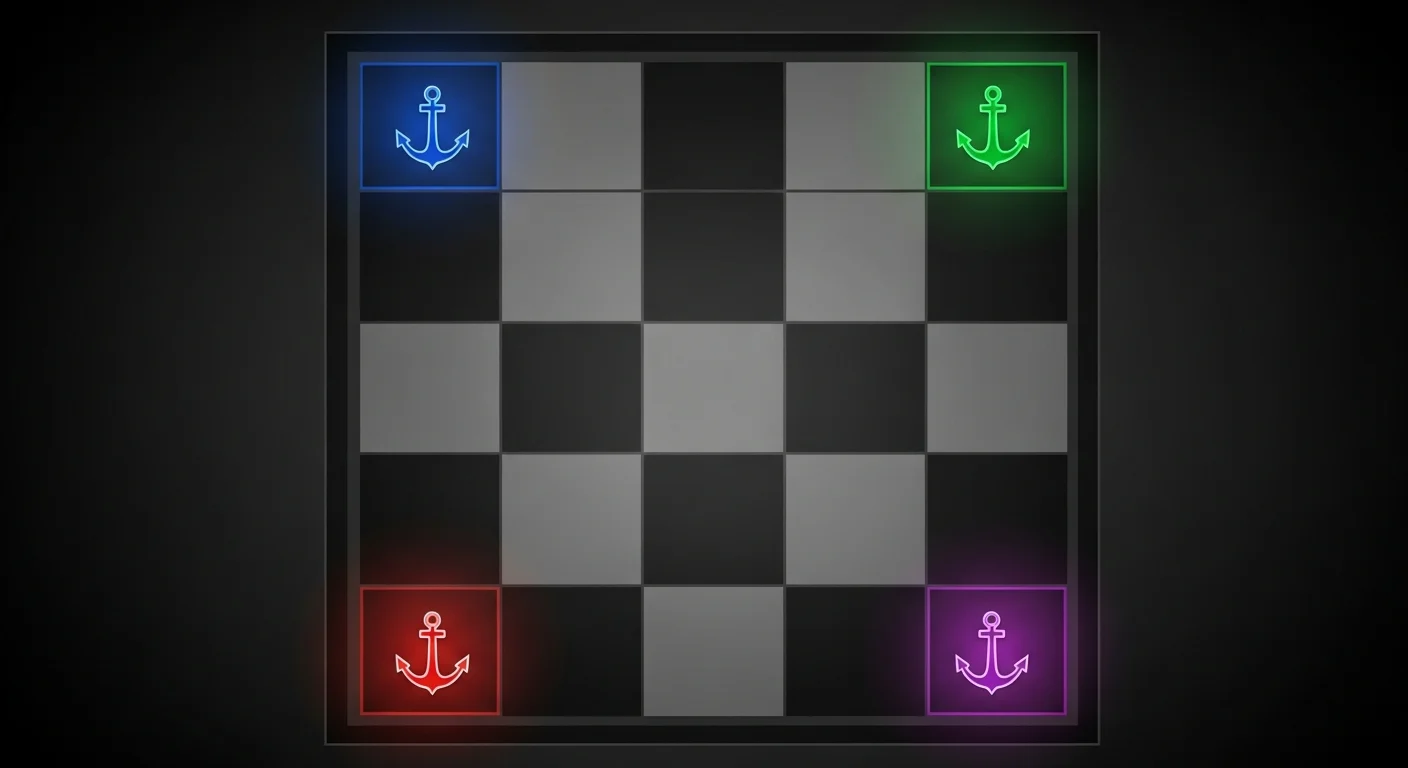
Memorize a1 and h8 as dark, a8 and h1 as light. These anchors stabilize your entire mental board.
Color awareness also prevents illegal mental moves. A bishop on c1 cannot land on e3. On a physical board, your eyes catch this instantly. In blindfold play, only memory stands guard. Deliberate chess visualization training strengthens that guard.
The technique relies on patterns, not rote facts. You are not memorizing 64 colors. Instead, you internalize the alternating board logic. Files and ranks alternate predictably, creating a structure you can reference quickly. Once this pattern feels automatic, any square’s color becomes easy to derive.
You have likely wondered how grandmasters play without seeing the pieces. The secret often begins with knowing each square’s color. Many players skip this foundation and chase complex calculation. That is like running before walking. Here is a structured path that builds clarity step by step.
The DarkSquares training exercise overview
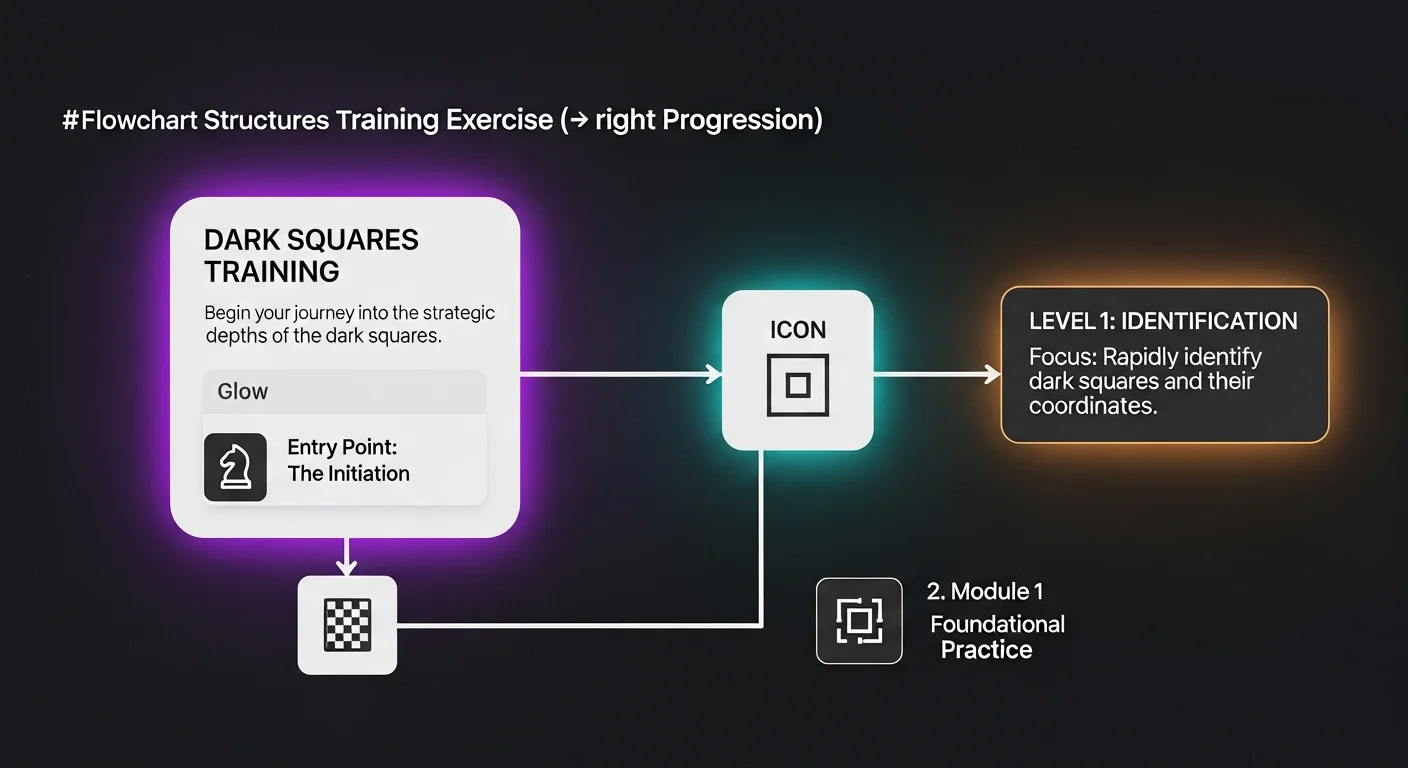
Unlike scattered practice, these DarkSquares exercises give a clear progression. The platform shows coordinates, such as e4 or h3, and you identify the color without a board.
Each session ramps up gradually. At first, you may hesitate. That is normal. Early rounds allow time to form mental patterns. As you improve, intervals shorten and sequences lengthen. You learn to recall under pressure.
The interface removes distractions. You see a square, choose light or dark, then get immediate feedback. This rapid loop accelerates learning. Meanwhile, accuracy and speed are tracked, so your weak spots become obvious.
Beginners get a gentle start. Early chess training sessions introduce the skill without overload. Experienced players can jump to faster modes that demand rapid recall. Both routes build the same outcome, automatic color awareness that supports reliable blindfold play.
Exercise Type | Focus Area | Best For |
|---|---|---|
Basic Recognition | Single square identification | Building initial mental map |
Timed Challenges | Speed under pressure | Developing automatic recall |
Sequence Mode | Multiple squares in succession | Maintaining focus during games |
Behind the scenes, performance data guides practice. The system targets squares that consistently trip you up, often central ones without landmarks. You spend time where it matters most. That adaptive focus prevents wasted effort.
The transformation arrives when you stop thinking and start knowing. After steady practice, your brain answers before you consciously ask. At that point, visualization becomes smooth, not forced. From there, you can tackle advanced chess visualization with confidence.
Repetition without reward drains motivation quickly. You know daily drills help, yet static boards grow dull. Platforms built on chess gamification turn tedious work into engaging challenges. When training feels like play, consistency follows, and consistency builds blindfold strength.
Embracing the gamification of chess training
Modern platforms understand our psychology. We crave progress, competition, and rewards. Consequently, sites like Chess.com and tools like ChessBase continue to integrate game-like elements into training to enhance skills such as board visualization and strategic thinking. Fritz 20 even analyzes style using data from Lichess games are becoming increasingly popular, with many players using the platform for practice and improvement., then adapts feedback as you improve.
DarkSquares applies this approach to square colors specifically. Instead of generic puzzles, you face timed color challenges with rising pressure. Correct answers earn points. Streaks reinforce consistency. Leaderboards create healthy competition with players worldwide.
These elements fuel intrinsic motivation more reliably than willpower. Watching your name climb a leaderboard intensifies focus. Progress bars make accuracy visible and actionable. As a result, weak patterns are corrected before they harden into habits.
The training benefits go beyond enjoyment. Gamified systems drive precise micro-adjustments. If diagonal recognition lags, the platform schedules more of it automatically. You practice exactly what needs work, guided by data rather than guesswork.
Youth players benefit strongly from this structure. Danny Rensch, Chief Chess Officer at Chess.com, notes:
"We've seen high school teams achieve unprecedented gains via isolated training, winning nationals.
Immediate rewards and clear paths resonate with learners used to rich feedback.
Traditional Drills | Gamified Training |
|---|---|
Self-paced with no external motivation | Leaderboards and streak tracking drive daily engagement |
Generic exercises regardless of skill level | Adaptive difficulty based on performance data |
Progress measured subjectively | Quantified metrics showing improvement over time |
Isolated practice with no community | Social features connecting players with similar goals |
Gamification also maintains novelty. Random modes, shifting time controls, and bonus rounds prevent autopilot. Your brain stays alert because challenges keep changing. That sustained attention beats rote repetition.
Public tracking adds gentle accountability. Friends or clubmates can see your training streaks. You are less likely to skip when others might notice. Social pressure becomes support for your habit.
The Psychology of Streaks
Consecutive-day streaks trigger loss aversion. After several days, breaking the chain feels costly, which sustains practice.
The key is alignment. Choose platforms where points reflect real skill, not empty clicks. DarkSquares ties every score to blindfold chess competency. Badges reward measurable progress in the mental architecture of unsighted play.
Hard work still matters. Gamification simply makes it sustainable. By turning mastery into engaging micro-challenges, these systems help you accumulate the thousands of quality reps that blindfold chess requires.
Most players can recall a position after looking at a board. Close your eyes and name e4’s color, though, and things get hard. Training improves cognition across many studies, yet few use square color drills consistently. This section shares targeted methods to improve blindfold with square colors training and convert abstract patterns into vivid mental images.
Key techniques to enhance board visualization
Professionals rely on structure, not magic. They build clarity one reliable cue at a time.
Start with anchor squares. Do not memorize all 64 at once. Pick a1 (dark), h1 (light), a8 (light), and h8 (dark). Use them to trace colors. From a1 to e4, count four right to e1 (dark), then three up to e4 (light). Tracing cuts cognitive load and raises accuracy.
Next, prefer patterns to memorization. Diagonals form same-colored stripes. The a1–h8 line is entirely dark. The a8–h1 line is completely light. Grouping squares by stripes halves the mental effort.
Apply chunking. Divide the board into quadrants, such as a1–d4 or e5–h8. Learn each section’s pattern separately. The logic repeats across quadrants, so mastery compounds quickly. This mirrors how chess memory training builds spatial skill in manageable blocks.
Then, run hypothetical scenarios. Visualize a familiar opening, like the Italian Game. As you place each piece mentally, say the square’s color aloud. This merges tactics and color recall. A 2013 Italian study found that combining cognitive skills boosts problem-solving effectiveness.
Technique | Best For | Time Investment |
|---|---|---|
Anchor Squares | Beginners building foundations | 5 minutes daily |
Diagonal Patterns | Reducing memorization effort | 10 minutes weekly |
Chunking Quadrants | Systematic learners | 15 minutes per quadrant |
Scenario Visualization | Integrating tactics with colors | 20 minutes per session |
Technique alone is not enough. Consistency beats intensity. Ten focused minutes daily outperforms a weekly hour. Spaced repetition consolidates memory between sessions.
Try verbal rehearsal. Say colors aloud while walking or commuting. Auditory feedback reinforces visual pathways. When you confirm f6 as light aloud, recall accelerates under pressure.
Embrace error-driven learning. Occasionally guess a color, then correct it immediately. That correction flags importance in memory. Active fixes stick better than passive repetition.
Finally, use reverse engineering. Pick dark squares and list as many as possible in 30 seconds. This inversion forces faster pattern access. According to Danny Rensch, "Chess players benefit from things that allow them to focus on what matters... ability to be present, to focus on the moment." Reverse drills sharpen that focus.
Combine methods thoughtfully. Begin with anchors and stripes. Add chunking as confidence grows. Layer scenarios and verbal rehearsal when ready. Matching technique to level prevents overwhelm and builds durable visualization techniques for blindfold and over-the-board play.
Most players start strong, then life interrupts and habits slip. Sporadic effort will not rewire your visualization. A sustainable routine that weaves color work into daily study turns scattered practice into lasting skill. Here is how to make consistency stick.
Maintaining consistency in training routines
Begin with honest scheduling. Your day is not a professional’s day, and that is fine. Carve out 15 to 20 minutes for focused color drills. Frequent, bite-sized work beats weekly marathons.
Danny Rensch’s team saw rapid gains with isolation training over several years. Likewise, a 2014 meta-analysis from Saint Louis found significant cognitive gains with regular training. The takeaway is simple. Showing up reliably matters more than perfect sessions.
Set measurable targets that evolve. Aim for 20 correct squares in 60 seconds on DarkSquares. Maintain that for a week, then raise to 25 or cut the time. Small, steady increases prevent plateaus and maintain momentum.
Track your numbers in a simple log. Record accuracy, speed, and difficulty. Patterns will emerge. Maybe mornings feel sluggish, while evenings fly. Adjust to match your peak windows.
Building a balanced training ecosystem
Integrate color work with other skills. Spend 15 minutes on DarkSquares, then move to tactics that demand mental placement. This linkage connects abstract board knowledge to practical calculation.
Training component | Time allocation | Purpose |
|---|---|---|
Square color drills | 15-20 minutes | Build foundational board awareness |
Tactical exercises | 20-30 minutes | Apply visualization in concrete scenarios |
Game analysis | 15-20 minutes | Contextualize patterns in real positions |
Rest days | 1-2 per week | Allow neural consolidation |
Rotate formats to avoid fatigue. Alternate speed drills, accuracy rounds, and pattern work on DarkSquares. Occasionally add partial blindfold games to see transfer into play. These applications remind you why the foundation matters.
Beware the consistency trap
Showing up is not enough if attention drifts. Five focused minutes beat twenty distracted ones.
Review weekly to refine your plan. Identify patterns that stall progress and adjust the mix. Thoughtful tweaks transform raw consistency into smart persistence.
Overcoming inevitable disruptions
Life will interrupt training. Use a minimum viable practice on busy days. Try five quick squares before bed or one short drill at lunch. These micro-sessions keep pathways active.
When returning after a gap, rebuild gradually over several days. Avoid cramming to repay missed time. Sustainable intensity prevents burnout and protects learning quality.
"Consistency isn't about perfection, it's about persistence. Missing one day doesn't erase your progress, but quitting does."
Seek accountability. Join a club or find a training partner with similar goals. Share DarkSquares screenshots or discuss tricky patterns. Community support carries you through slow weeks.
Celebrate small wins. Notice when colors emerge effortlessly mid-game. Those moments prove your daily work is reshaping how you see the board.
You have seen how square colors power blindfold play. Now convert knowledge into skill. Many players read and nod, then move on. Avoid that trap. Your progress depends on what you practice in the next 24 hours.
Next steps in your chess improvement journey
Set concrete milestones, not vague hopes. For example, visualize five games this week using color groupings. Or master one opening line blindfold, tracking light versus dark occupancy. Clear targets make progress visible and motivating.
Track sessions in a simple log. Note color transitions that cause errors and how many moves you hold accurately. After two weeks, patterns will stand out. Then you can attack weak areas with precision.
Start with endgames to simplify the task. Fewer pieces reduce cognitive load. Practice rook or king and pawn endgames on specific colors. Then expand to richer positions as confidence grows.
Connect with others to accelerate learning. Clubs offer live blindfold partners. Online forums like r/chess and Chess.com discussions provide tips and accountability. Collaboration prevents reinventing solutions alone.
Focus on four areas in rotation. First, run short pattern-recognition drills that link tactics to color. Second, build endgame skill by visualizing pawn races and key squares. Third, map one opening’s first 8 to 10 moves by color occupancy. Fourth, extend calculation depth from two to four moves using colors as anchors.
Choose tools that fit your routine. Lichess analysis boards support mental visualization without moving pieces. Chess Tempo offers puzzles for head-only solving. Even simple flashcards speed up color mapping more than you might expect.
Resource Type | Best For | Time Investment |
|---|---|---|
Chess clubs | Live blindfold practice, immediate feedback | 2-3 hours weekly |
Online forums | Strategy discussions, finding training partners | 30 minutes daily |
Puzzle platforms | Tactical pattern recognition without a board | 15-20 minutes daily |
Analysis tools | Reviewing positions mentally, building repertoire | 20-30 minutes 3x weekly |
Consistency beats intensity. Five focused sessions of 15 minutes will outperform one 90-minute grind. Your brain consolidates skill through frequent, light touches.
Vary the format to keep attention high. One day, solve tactical patterns using colors. Next, replay a master game in your head, move by move. Then play a short blindfold game with a partner. Variety reinforces the same core skill from fresh angles.
Structured programs help some learners. Others thrive with self-guided plans. Either way, cover visualization, calculation, pattern work, and practical application. A balanced framework prevents wandering.
Expect plateaus. Some weeks feel easy, others foggy. That fluctuation is normal reorganization, not failure. Keep practicing through the dip. Breakthroughs follow the frustrating stretches.
For immediate application, try a free DarkSquares blindfold exercise centered on square colors. Difficulty scales with your accuracy, and instant feedback highlights gaps faster than solo work.
Take one micro-action now. Pick light or dark, close your eyes, and name every square of that color from a1 to h8. Time yourself and record the result. Repeat the test in two weeks to measure your progress.
Frequently Asked Questions
Last updated: Feb 24, 2026

Antoine Tamano
Angers France
I’m Antoine Tamano, founder of Instablog — a tool that helps businesses turn existing website content into a consistent, SEO-friendly blog. After working with startups and larger companies, I saw how hard it was to keep up with blogging, even when the value was clear. Instablog was born from a simple idea: make blogging easier using what’s already there. Here, I share what I’ve learned building Instablog and why smart content should be core to any growth strategy.


