
Why Play Blindfold Chess? 7 Reasons from History and Science
Why play blindfold chess? Imagine tackling chess without sight, recalling every move across many games. Grandmasters like Timur Gareyev embrace this challenge to transcend visual play. In 2016, he played 48 blindfold games simultaneously, setting a record. The challenge is translating visual gameplay into a mental pursuit. Discover why blindfold chess elevates perception and strategy by removing sight. If you want to go further than this overview, the full blindfold chess learning hub collects every technique, drill, and progression path on one page.
The intrigue of blindfold chess: Beyond the ordinary
A player sits away from the board, often wearing a blindfold, while an arbiter announces moves. The blindfolded player responds using notation only. Each move is visualized on an imagined grid. The spectacle intrigues audiences who watch someone manage positions, tactics, and strategies without seeing anything. Drama peaks in simultaneous displays, where one faces multiple boards. George Koltanowski set a benchmark in 1937 with 34 blindfold games at once, a record for decades. The allure is the total internalization required, as misremembering can corrupt the entire model. Blindfold training enhances chess perception, making tactics like diagonals and pins stand out more vividly than on a board. Our complete history of blindfold chess world records traces the progression from medieval Islamic courts to Gareyev's 48 boards.
Understanding the challenges: Mental gymnastics in action
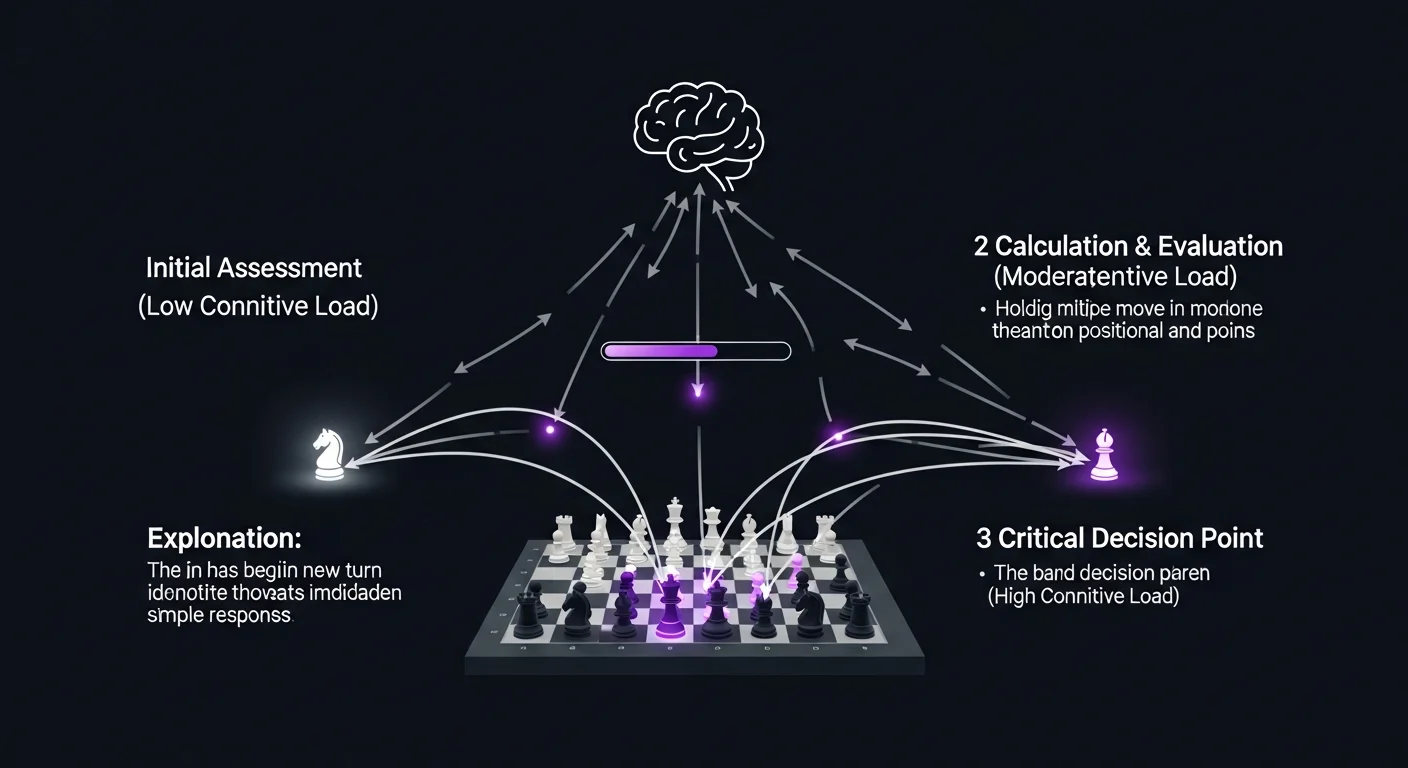
The cognitive load splits across tracking piece locations, calculating variations, and maintaining evaluations. Working memory must hold 32 pieces across 64 squares while simulating unseen moves. Without a board, a missed intermezzo or capture causes position drift, ruining calculations.
Timur Gareyev's 2016 feat illustrates blindfold chess's complexity. Competing against multiple opponents without visual aids, players demonstrate impressive mental prowess by tailoring strategies for each match, highlighting the cognitive benefits of blindfold chess. Worried the effort might harm your cognition? We unpack the evidence in what science actually says about blindfold chess safety.
The psychological allure: Why players are drawn
Blindfold chess offers a clean test of calculation under pressure. Records like Gareyev's 48-board simul drew skeptics calling it a stunt. His strong performance against diverse opponents demonstrated the effectiveness of systematic visualization training.
The focus feels addictive. The Amber tournaments (1992 to 2011) paired rapid with blindfold rounds equally, with elite players training for them specifically. Blindfold chess remains high-profile today through exhibitions and online events, where top players occasionally demonstrate the skill for audiences and streamers. Historical champions like Viswanathan Anand and Levon Aronian credit visualization training as a key part of their strength, since deep calculation in classical play relies on the same mental imagery.
The psychological draw goes beyond spectacle. Players often report a heightened sense of flow when the board exists only in the mind. There is no distraction from the surroundings, no ambient noise, no worry about knocked pieces. The position lives entirely in your working memory, and every threat, plan, and candidate move shares the same mental workspace. Many players describe this as a cleaner, more immediate form of chess thinking. Curious what that flow actually rewires? Our deep dive on the mental benefits of blindfold chess covers the working memory and pattern-recognition research behind it.
Some find mental boards clearer than crowded tournament tables. Poor lighting or noise does not affect a game that lives in your head. "Patterns such as long diagonals or hidden pins are easily noticeable without pieces obstructing the lines." Systematic visualization training turns flashes of insight into reliable skills, and you can extend the same skill set across the board with our complete guide to chess visualization training.
The historical roots of blindfold chess: An ancient practice
Playing without sight dates back to the 9th century in Islamic courts, where chess indicated intellect and discipline. It spread into Europe via Spain and Italy by the 13th century, accepted as an intellectual feat.
In 1783, at Parsloe's Coffee House in London, François-André Danican Philidor played three simultaneous blindfold games, astounding onlookers. Accounts describe him recalling games days later. He had given earlier blindfold exhibitions at Paris cafés from the 1740s onward, but the three-board simultaneous feat in London became his most celebrated achievement. He memorized positions and patterns, a method modern players use for visualization.
In the 19th century, exhibitions became testing grounds for theory. Harry Nelson Pillsbury and Joseph Blackburne played 12 to 22 blindfold games at a time, demonstrating organized memory handling extensive information, shaping ideas on piece coordination and board relationships. Starting with fundamental movement patterns builds today's equivalent of their skills.
Practical implications: Beyond the chessboard
Blindfold training enhances spatial working memory in ways that extend beyond chess. Visualizing knight forks and pawn structures uses systems surgeons rely on to map anatomy, architects to rotate plans, and programmers to track variables across functions. It turns abstract positions into stable mental images for quick queries and updates.
The biggest transfer is to sequential planning. Your brain juggles contingent lines, like "If Nf3, then d5, creating three viable redeployments." This mirrors project timelines with dependencies, branching legal arguments, and step-by-step medical diagnoses where one result changes the next decision.
Start simple. Spend five minutes visualizing a single piece moving on an empty board. Name each square aloud as a white knight tours from a1 toward h8. In week two, add a second piece and track both. Within a month, meetings feel easier to recall, mental math speeds up, and complex problems with many variables feel less tangled. Practice coordinate recognition to lock in the basics making blindfold play possible, or follow the graduated AI difficulty ladder in our structured blindfold journey.
Key takeaways
Blindfold chess trains spatial working memory that helps in surgery, architecture, and software debugging.
Focused visualization improves pattern recognition speed and reduces errors under time pressure.
Holding contingent scenarios in mind maps directly to planning in projects, law, and medicine.
Begin with single-piece drills before attempting full positions or simuls.
Benefits compound because you are upgrading how you process spatial information.
Take action today: Set a five-minute timer and visualize a single knight moving from a1 to each square on the first rank, naming coordinates aloud without looking at a board. When you are ready for a real opponent, jump into a live blindfold game, or unlock the full progression with DarkSquares Pro.
Related reading
- Blindfold Chess for Beginners: 7-Step Journey, the exact sequence to go from zero to your first blindfold games.
- Mental Benefits of Blindfold Chess, science-backed deep dive on working memory and pattern recognition.
- Is Blindfold Chess Dangerous?, the evidence on safety and mental fatigue.
- Blindfold Chess World Records, from Sa'id ibn Jubair to Gareyev's 48 boards.
- 9 Essential Blindfold Chess Exercises, progressive drills with measurable benchmarks.
- Five Mindset Shifts + Your Roadmap, the psychological side of the skill.
- Coaching Blindfold Chess, 5 tips for instructors and self-coaching students.
Frequently Asked Questions
Last updated: May 9, 2026


