
Could you play a full game without seeing the board? Practicing Blindfold Chess: Where to Start? begins with that daring question. Many players want sharper calculation and memory, yet feel lost on day one. The first attempts often overwhelm, and progress stalls without structure. This comprehensive guide gives you a clear starting point and a stepwise plan. You will learn essential visualization habits, avoid common traps, and balance training with regular play. By the end, you will know exactly how to practice blindfold chess with confidence.
Understanding the allure of blindfold chess
In 2016, Grandmaster Timur Gareyev played 64 blindfold games at once, winning 54. No board, no pieces, only memory and logic. Feats like this captivate players and raise a hopeful question: can I learn it? With disciplined practice, most improving players can.
Blindfold chess removes the visual safety net. Instead of glancing at pieces, you must hold the entire position in your mind. This shift reveals how we recognize patterns and process space. As researchers Giovanni Marchesich and Laura Tamburini note, blindfold chess becomes a special type of chess game that stretches visualization and pattern recognition beyond standard play.
Many players experience positive effects in their regular games. Memory strengthens through recalling positions without visual cues. Strategic thinking deepens because you must understand each position, not just inspect it. Calculation becomes smoother since you already manipulate positions mentally.
Interest in blindfold chess is on the rise again. Interest in blindfold chess saw a notable increase in April 2024. The upcoming 2025 Blind Chess Olympiad also shows strong competitive momentum worldwide.
The rewards often spill into daily life. Yet every expert began there. The difference is a systematic approach. If you want a structured path to blindfold training, building a foundation matters more than rushing ahead.
Why start with learning the basics?
Building without a foundation invites collapse. The same is true here. Attempting blindfold chess without board geometry creates cognitive chaos. You need a mental map before you can navigate it sightless.
Basic skills form the bedrock of visualization. First, algebraic notation must feel automatic. Your mind should map e4 to a clear square instantly. If naming any square takes more than a second, strengthen that skill first. Otherwise, you waste energy decoding coordinates instead of calculating.
Piece movement patterns deserve equal attention. Knights hop in L-shapes, bishops slice diagonally, and rooks travel straight. These are more than rules; they are neural pathways. Notably, Chabris and Hearst (2003) found masters showed similar performance in rapid and blindfold tasks, suggesting strong fundamentals transfer well.
Start with single-piece journeys
Visualize one piece on an empty board for 30 seconds daily. For a knight, name each square aloud as it hops.
Learn basic tactics through visualization, then confirm on the board. Picture forks, pins, and skewers with eyes closed. Next, open your eyes to verify the patterns. This cycle, mental rehearsal followed by visual feedback, strengthens crucial connections.
Rushing past fundamentals causes overload. Working memory handles only a few chunks at once. Without solid basic chess skills, you spend that capacity tracking pieces rather than planning. Many players quit blindfold practice for this preventable reason.
The time invested now saves countless hours later. These blindfold chess techniques also sharpen normal board vision. When you see positions clearly in your mind, over-the-board analysis feels easier. This groundwork pays dividends across your chess journey.
Creating a mental map of the chessboard
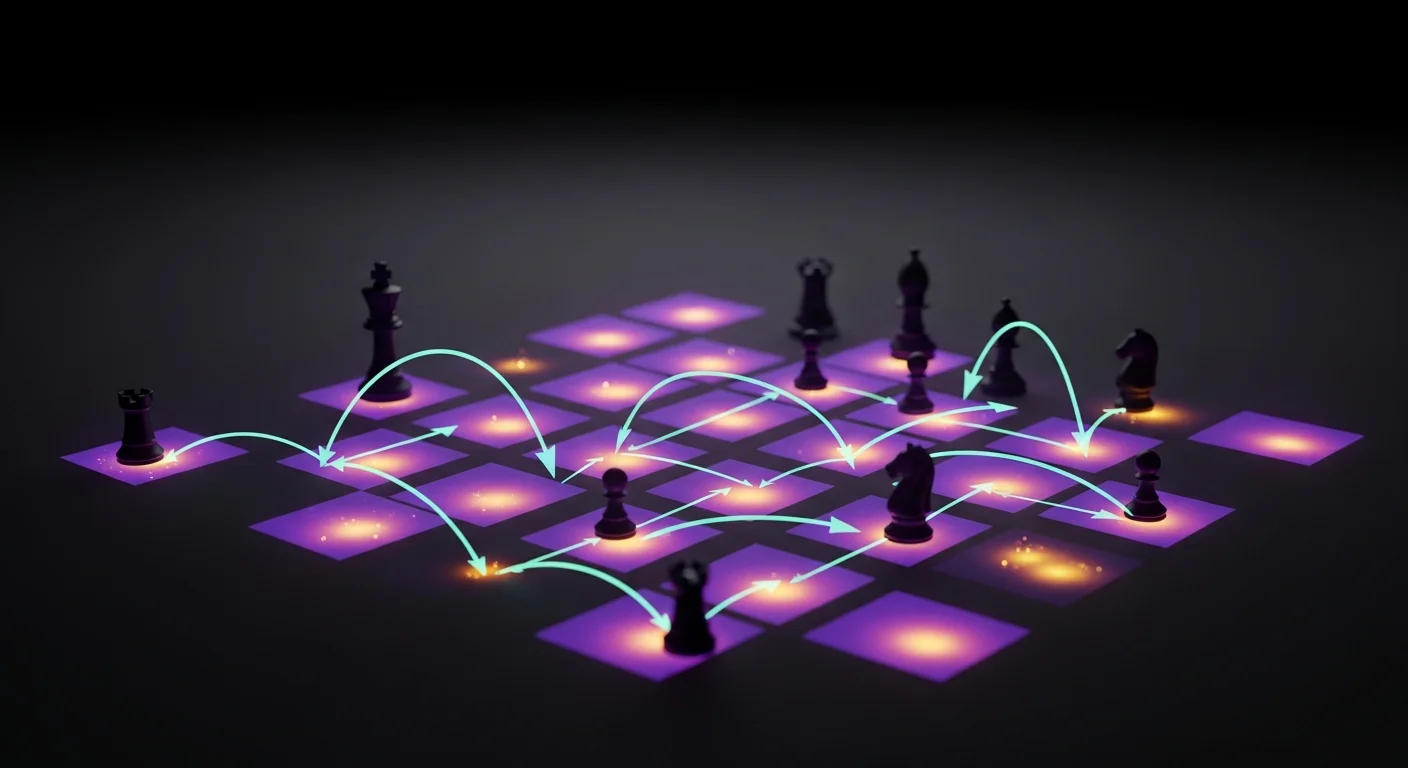
Attempting blindfold play without a mental map invites confusion and blunders. Before you can calculate in your head, build a reliable internal board.
This map is not just piece locations. It is the 64 squares, their colors, and how they connect. Strong chess visualization means you can see this grid when your eyes are closed, like recalling a familiar floor plan.
Begin with algebraic notation as landmarks. Each square has a unique address. When you hear “knight to f6,” the square should appear instantly. Practice turns abstract letters into concrete spaces. Also memorize anchors first, the four corners and the four center squares. They help you orient the rest of the board quickly.
Try this exercise with an empty board in mind. Focus on a1, a dark square. Travel across the first rank, naming squares aloud: a1, b1, c1, d1, e1, f1, g1, h1. Notice the alternating colors.
Repeat for every rank. Then reverse direction from h8 down to h1. It may feel tedious at first, but this builds your spatial framework. Skipping it leads to losing track later.
Verbalizing matters. Speaking engages additional neural pathways and mirrors blindfold play, where moves are announced aloud. It reinforces the link between notation and space.
Next, practice files. Start at a1 and go vertical: a1 through a8. Then move to the b-file and continue. Many players find vertical movement less intuitive, so it is valuable training.
| Practice Pattern | Focus Area | Typical Mastery Time |
|---|---|---|
| Horizontal (ranks) | Left-right orientation | 3-5 days |
| Vertical (files) | Up-down awareness | 4-6 days |
| Diagonal patterns | Bishop-like movements | 1-2 weeks |
| Knight jumps | L-shaped connections | 2-3 weeks |
After straight lines, add diagonals. Choose a square and trace all four directions. From e4, you can reach a8, h1, b1, and h7. These paths become crucial when tracking bishops and queens.
Now train knight moves. Their L-shapes confound many players. From d4, a knight can reach eight squares. Try naming them without a board. Repetition converts guesswork into certainty.
Use color patterns as quick checks. Dark and light squares form diagonal chains. If you imagine a bishop switching colors mid-path, something is off. Correct it immediately.
"The board exists in my mind as clearly as if I were looking at it. Each square feels distinct, like rooms in a familiar building." A grandmaster describing developed visualization.
Consistency beats duration. Five daily minutes build stronger pathways than sporadic long sessions. After two weeks, most players see clear improvements in board awareness.
Test yourself with random squares. Can you instantly picture each location and color? Can you name which pieces from the starting position attack that square in one move? These checks reveal gaps to fix.
Remember, everything else rests on this map. Without it, you are navigating a city with no street layout. Invest now, and structured visualization training becomes far easier.
Incremental approach to mastering blindfold chess
You have the foundation. Now avoid the classic mistake, doing too much, too fast. The gap between one-piece drills and full blindfold games is real. Nobody crosses it in one leap.
Meet Sarah, a 1600-rated player who tried full games for months. She lost track around move seven and felt defeated. Then she reset her approach. She practiced only three moves per side, then reset and repeated.
Within a week, six half-moves became eight. Two weeks later, she tracked twelve moves reliably. The breakthrough was simple. Incremental learning is not lowering standards, it is building sustainable skill.
Starting with bite-sized challenges
Begin with positions you can hold without strain. Play 1.e4 e5 2.Nf3 Nc6 3.Bb5 in your head. Can you still see the resulting position five minutes later? If not, you found your starting point.
Add one move at a time. When you can visualize three moves per side, push to four. Then five. Chessable’s blindfold tactics project reported a 16% faster solving time with structured progressions, and 31% for a phased experimental group.
These results matter. Methodical progression beats heroic effort. Your brain adapts to manageable challenges and builds durable pathways. Rushing is like sprinting before you can walk.
The Three-Move Checkpoint
After each set of three moves, pause and verify every piece. If anything feels uncertain, check and restart from the last clear position.
Tracking your progress with milestone metrics
Measure what you want to improve. Keep a simple log with date, longest accurate sequence, and when your mental image degrades. Patterns will emerge within weeks.
Set specific benchmarks. Hold a position for five moves, or solve a three-move tactic without a board. Write down results and adjust when you plateau. Tracking converts wishful thinking into visible progress.
Building resilience through deliberate practice
Progress will not be linear. Some days feel easy, others do not. On tough days, return to simpler positions rather than push through sloppiness.
This builds resilience and useful self-awareness. You will learn when your mental board is sharp and when it needs rest. Metacognitive skill becomes a quiet advantage.
The key insight is balance. Expand your capacity with challenges at your growth edge. Push too hard and you burn out. Stay too safe and you stall. Aim for stretched, not strained.
Ready to apply this stepwise plan? Structured blindfold training tools help you track progress and maintain disciplined progression. The path to confident blindfold play is methodical and repeatable.
Balancing blindfold practice with regular play
Treat blindfold chess like strength training. It builds power, but you also need real games to apply it. Overemphasis on one side hurts the other.
Integration is the goal. Blindfold work sharpens mental muscles. Regular play teaches when and how to use them. Players who only visualize struggle over the board. Those who never visualize miss deep pattern recognition.
Research supports a blended approach. Chessable’s analysis found players improved Rapid Elo by 26% when adding blindfold tactics. They did not abandon regular training; they supplemented it.
So what is the right mix? Most coaches suggest 20 to 30 percent blindfold practice. That leaves space for openings, visible-board tactics, endgames, and real games. Blindfold becomes a tool, not the whole workshop.
The 70-30 Rule
Spend 70% of your time on visible-board training. Use 30% for blindfold work. This balance keeps progress steady and skills connected.
Here is a practical weekly schedule many players use:
| Day | Regular Practice (70%) | Blindfold Practice (30%) |
|---|---|---|
| Monday | Opening repertoire study (45 min) | Blindfold knight tour (15 min) |
| Tuesday | Tactical puzzles with board (30 min) | Visualized tactics (10 min) |
| Wednesday | Play rated games (60 min) | Review one game blindfolded (20 min) |
| Thursday | Endgame study (40 min) | Blindfold mate-in-ones (10 min) |
| Friday | Opening review + tactics (50 min) | Short blindfold game (15 min) |
| Weekend | Longer games + analysis (90 min) | Blindfold position reconstruction (30 min) |
Notice how blindfold work supports core activities. You still play, solve puzzles, and study openings. Blindfold sessions reinforce, rather than replace, those efforts.
Blend both directions. While solving a board puzzle, pause and finish it blindfolded. During post-game review, reconstruct one key position mentally. These micro-moments weave visualization into your routine.
Match difficulty to your level. Simple motifs like pins and forks suit blindfold training. Highly complex middlegames with many pieces are better on a visible board. Calibrate challenges for steady gains.
This complementarity creates a virtuous cycle. Blindfold practice speeds calculation in real games. Real games expose visualization gaps to target next. Each practice strengthens the other.
Some fear blindfold work slows decision-making. Initially, it might. After a few weeks, most players report faster calculation. Visualization becomes automatic, not a drag.
Want to structure time effectively? Visualization tools help balance blindfold work with over-the-board skills. The goal is simple, become a stronger overall player.
Common obstacles and how to overcome them
You will lose pieces in your head. Everything seems clear, then a knight disappears. It is frustrating, especially after many careful minutes.
Memory lapses strike at critical moments. In complex calculations, you forget whether a rook sits on d1 or e1. Anxiety makes it worse, since you now juggle both position and panic.
When this happens, stop rebuilding the entire position at once. Reconstruct systematically. Start with pawns, then major pieces, then minor pieces. Announce that you need a moment, then rebuild carefully. A one-minute reset beats guessing from a faulty image.
Mental fatigue arrives before you notice it. After twenty minutes, accuracy often dips. You might make basic errors or lose track of move order. These signs mean your brain needs a short break.
Short, focused sessions work best. Fifteen to twenty minutes of blindfold practice beats an hour of struggle. Take five-minute breaks between attempts. Look at a distant object or close your eyes completely to reset.
Set realistic milestones to reduce frustration. First, complete one blindfold game without peeking, regardless of move quality. Next, hold accuracy for ten moves. Then, execute one clean tactical sequence blindfolded. Each step builds confidence.
| Obstacle | Why It Happens | Practical Solution |
|---|---|---|
| Losing track of pieces | Working memory overload during complex positions | Rebuild systematically by piece type, starting with pawns |
| Mental exhaustion | Visualization requires intense continuous focus | Keep sessions under 20 minutes with 5-minute breaks |
| Performance anxiety | Fear of making obvious mistakes without seeing the board | Practice alone first, then with supportive partners |
| Motivation drops | Progress feels slow compared to regular chess improvement | Set specific small milestones rather than vague goals |
Performance anxiety deserves special attention. Worry shrinks working memory and becomes self-fulfilling. Many players visualize well alone but freeze with an audience.
Use gradual exposure. First, practice alone until you complete several clean games. Then play with one supportive friend. Only later add less familiar opponents. Comfort should grow step by step.
Plateaus are common. Some handle openings and middlegames but fail in endgames. Others do the opposite. Neither pattern signals a fatal flaw. It shows where to aim your training.
For middlegame trouble, think in patterns rather than single squares. See “knight on the rim” as one concept, not just “knight on a4.” For endgames, train king and pawn calculation, since precise counting matters most.
Consistency beats intensity. Three twenty-minute sessions each week outperform irregular marathons. Regular practice builds pathways gradually and prevents burnout.
Ready to link blindfold skills to real gains? Structured visualization training helps you track blindfold progress and over-the-board transfer, turning today’s obstacles into tomorrow’s rating jumps.
Take the first step: Your practice plan
Starting blindfold chess does not require an overhaul. Small, consistent sessions fit easily into your routine. Many players fail by attempting hour-long efforts immediately and burning out.
Think of your plan as a ladder. Your first goal is not a full blindfold game. It is one accurate visualized move. Add complexity slowly, letting each success support the next rung.
Building your weekly structure
Begin with three 10-minute sessions per week on separate days. Spacing matters because your brain consolidates skills between sessions. Monday, Wednesday, and Friday work well for most players.
During week one, focus on navigation. Pick a square and name all knight destinations without a board. When that feels easy, add a second piece to the mental board. By week two, visualize interactions, such as a bishop and a rook.
Use an 80 percent accuracy rule. Move to the next difficulty only when you succeed in eight of ten attempts. Advancing too early creates gaps that are harder to fix later.
Week three adds simple tactical patterns. Visualize a knight fork or a bishop pin. These short scenarios train multi-piece tracking without full games. As patterns solidify, extend sessions to 15 minutes.
By week four, attempt a five-move sequence. Play a simple opening line without a board, then verify on a real setup. Treat mistakes as useful signals. They show exactly which movements you lose under pressure.
Tracking progress without overwhelming yourself
Keep a simple log with date, exercise, and accuracy rate. It takes seconds and yields valuable insight. If diagonals or pawns cause trouble, adjust your next session.
Sarah Chen, rated 1600, began at three reliable moves. She committed to ten minutes daily, logging every attempt. Three months later, she completed her first blindfold game. Six months later, she won a local event. Her edge was consistency, not talent.
Evolve your plan as you grow. After mastering five-move sequences, move to eight, then twelve. Later, train full lines, then middlegames, and finally complete games. Patience prevents avoidable plateaus.
Making practice sustainable
Attach blindfold sessions to a habit you already have. Practice after morning coffee or before tactics. Habit stacking reduces reliance on willpower.
On low-motivation days, still practice, but lower difficulty. Light work maintains momentum and strengthens pathways. Think of it like an easy gym day that protects your streak.
Find an accountability partner who is also learning. Share goals, compare logs, and set small challenges. The social element makes consistency easier during plateaus.
Ready to build these skills systematically? Structured blindfold training offers progressive exercises matched to your level, plus tracking that highlights improvement and reveals next steps.
Enhance skills with dedicated exercises
The fastest path is targeted practice, not just more games. Specialized drills strengthen the cognitive base that blindfold chess demands.
Tactical puzzles are ideal. Solving combinations mentally forces calculation without moving pieces. Start with two-move tactics, then increase complexity. Pattern recognition becomes automatic and frees mental bandwidth during games.
Replaying historical games provides different benefits. Follow master games move by move without a board. You will maintain long-term position awareness while absorbing strategic ideas. Pick games you enjoy, because engagement drives retention.
Build a Sustainable Practice Schedule
Consistency matters most. A practical plan includes daily visualization drills for 5 to 10 minutes, tactical puzzles three times a week, and one blindfold game on weekends. Adjust the schedule to fit your life so it lasts.
Anchor practice to routines. Solve one puzzle with your morning coffee. Replay three master moves before bed. Small sessions compound into meaningful gains.
| Exercise Type | Frequency | Duration | Primary Benefit |
|---|---|---|---|
| Visualization drills | Daily | 5-10 minutes | Board awareness |
| Tactical puzzles | 3x weekly | 15-20 minutes | Calculation depth |
| Game replay | 2x weekly | 20-30 minutes | Strategic thinking |
| Full blindfold games | 1x weekly | 30-60 minutes | Integration practice |
Find Community Support
Blindfold chess feels solitary, but community helps you persist. Online forums, Discord groups, and Reddit clubs share drills, organize matches, and troubleshoot challenges. Accountability keeps you practicing when motivation dips.
Books like “Play Winning Chess” by Yasser Seirawan and “The Amateur’s Mind” by Jeremy Silman are not blindfold manuals. They build positional understanding that lowers visualization load by clarifying what matters in a position.
Measure Your Progress Objectively
Use clear metrics. Track the longest accurate sequence, your highest-rated blindfold puzzle, and time to complete a ten-move game. Numbers reveal progress that feelings might miss.
Create personal benchmarks. Select five tactical positions and solve them monthly. When speed increases or errors drop, you have hard proof of improvement.
The ability to play blindfold chess is not a photographic memory. It is systematic habits that strengthen visualization over time.
Your First Action Today
Pick a familiar opening. Set a five-minute timer and replay the first ten moves in your head. Do not peek until time expires, then check accuracy and note the first divergence. Train that exact weak point tomorrow.
Want structured support for steady gains? Try progressive blindfold training with built-in tracking to target weaknesses and measure improvement session by session.
Frequently Asked Questions
Last updated: Feb 24, 2026

Antoine Tamano
Angers France
I’m Antoine Tamano, founder of Instablog — a tool that helps businesses turn existing website content into a consistent, SEO-friendly blog. After working with startups and larger companies, I saw how hard it was to keep up with blogging, even when the value was clear. Instablog was born from a simple idea: make blogging easier using what’s already there. Here, I share what I’ve learned building Instablog and why smart content should be core to any growth strategy.


