
Grandmasters play entire exhibitions without seeing a board. The spectacle is gripping. A 2023 study on blindfold chess training reported 31% faster solving and a 26% Rapid boost. Yet many club players lose the position after a few moves. The board fades, pieces drift, and calculation collapses under pressure. Practice often feels random and discouraging. This guide delivers a Structured Blindfold Chess Training Regimen you can follow with confidence. You will build visualization, memory, and focus step by step. By the end, you will own a repeatable plan for reliable blindfold play.
Understanding blindfold chess and its allure
Blindfold chess strips away the physical board and forces you to see everything in your mind. Players call out moves using algebraic notation while holding a complete mental picture of all 32 pieces. It can feel intimidating at first.
This discipline goes back centuries. Historians recorded Philidor playing blindfold games in 1783, astonishing Parisian audiences. By the 1930s, Alekhine played 32 simultaneous blindfold games. A former curiosity has become a respected training method.
The allure lies in pure cognitive chess. Without visual cues, you rely entirely on calculation, pattern recognition, and memory. Every square becomes a mental coordinate. Each piece relationship exists only in your imagination.
Why the brain loves this challenge
Blindfold chess recruits spatial memory, calculation, and pattern recognition at once, creating unusually efficient cognitive training.
Beyond the workout, blindfold chess reveals strategic depth you might miss. When you cannot glance for reassurance, you develop stronger internal strategies. Calculation becomes more rigorous, and visualization grows sharper.
Many players find that chess visualization training through blindfold practice transforms over-the-board play. Tactical patterns emerge faster, and candidate moves appear more clearly. The fog lifts as your mind learns to organize positions without external support.
Preparing your mind for blindfold chess
"Athletes warm up before competition." Latest research: **Current statistics on Structured Blindfold Chess Training Regimen are currently unavailable.** The most recent findings, based on a 2023 pilot study of 27 players (FIDE ratings 1650-2100 Elo), highlight the outcomes observed after 12 two-hour sessions over a three-month period[1][2][4]. ### Key Study Findings - **Solving time reduction**: According to Giovanni Marchesich and Laura Tamburini (2024), participants undergoing blindfold tactics training achieved a 31% reduction in tactic-solving time (from an average of 32 minutes initially to 27 minutes), versus a control group that saw a reduction of only 30 seconds per move (p>0.5) source.[1][2][3][4]. - **FIDE Elo gains**: An average increase in Rapid ratings was observed, with less significant gains in Standard ratings. Improvements were more pronounced for players with ratings over 1900 Elo (p<0.05) and for males (p<0.01)[1][2][3][5]. - **Training method**: The regimen involved a three-step cognitive path—memorizing notation, solving simple positions mentally, and analyzing 13 complex blindfold positions for a maximum of 40 minutes each, repeated after 20 days[1]. ### Structured Regimen Recommendations It is recommended to follow a systematic weekly schedule to replicate these improvements, highlighting visualization, consistency, and regular rest[3]. **Weekly Framework** (2.5 hours total, adjustable): | Day | Focus | Duration | Core Activity | |----------|----------------|----------|----------------------------------------| | Monday | Visualization | 30 min | Board recall, single-piece patterns[3] | | Wednesday| Tactics | 35 min | Blindfold puzzles (2-move start)[3] | | Friday | Game play | 40 min | Full blindfold game vs. software[3] | | Sunday | Review | 25 min | Analyze errors, track visualization[3] | **Progression Milestones**: | Timeline | Goal | Success Metric | |----------|--------------------------|---------------------------------| | Weeks 1-2| Board familiarity | Name squares <2 seconds[3] | | Weeks 3-4| Piece tracking | Follow 3 pieces/5 moves[3] | | Weeks 5-8| Position retention | Recreate middlegame/30 sec[3] | | Weeks 9-12| Short games | 10-move blindfold game[3] | **Supporting Exercises** (cognitive benefits): | Exercise Type | Benefit | Weekly Time | |------------------------|-----------------------------|-------------| | Memory games | Pattern recognition[3] | 15-20 min, 3x | | Spatial puzzles | Spatial reasoning[3] | 20 min, 2x | | Concentration drills | Sustained attention[3] | 10 min daily| | Working memory tasks | Variation management[3] | 15 min, 3x | The 2023 study suggests the need for larger follow-up studies to refine the protocol, with no recent updates available[1][2][4]. Consistent tracking of metrics such as puzzle time, accuracy, and calculation depth is recommended for personal advancement[3]. ## Sources [Source 1: https://www.chess.com/blog/Chessable/blindfold-chess-tactics-project] [Source 2: https://stm.bookpi.org/AOLLER-V7/article/view/16483] [Source 3: https://darksquares.net/blog/blindfold-chess/structured-blindfold-chess-training-regimen] [Source 4: https://pdfs.semanticscholar.org/91ae/b6430117ee736b4339b4a210b9aca3c882f7.pdf] [Source 5: https://darksquares.net/blog/blindfold-chess/your-2026-path-to-blindfold-chess-mastery] [Source 6: https://pmc.ncbi.nlm.nih.gov/articles/PMC10167585/] [Source 7: https://thechessworld.com/tcw-academy/intensive-blindfold-calculation-training-part-1-with-im-siddharth-ravichandran-tcw-academy/] [Source 8: https://www.chess.com/blog/Kyrylo26/the-benefits-of-blindfold-chess-for-every-chess-player] [Source 9: https://www.youtube.com/watch?v=vpRY6vUUXEE] [Source 10: https://pmc.ncbi.nlm.nih.gov/articles/PMC2972788/] [Source 11: https://www.chess.com/article/view/chess-1-1-1-study-plan] [Source 12: https://www.chess.com/blog/bjbalas/science-of-chess-playing-blindfold-and-seeing-chess-in-your-dreams] [Source 13: https://onlinelibrary.wiley.com/doi/10.1901/jeab.2010.94-373] They visualize plays and prepare their bodies and minds for peak performance. Your chess brain needs similar priming.
Mental preparation creates the readiness required to track invisible pieces on an imagined board. Without this foundation, you are asking your mind to run a marathon without training. The gap between seeing a board and imagining one feels large at first, but targeted exercises can bridge it.
Building visualization capacity
Start with static positions. Close your eyes and picture an empty chessboard. See the alternating squares and locate a1 in the bottom-left corner from White’s perspective.
Next, place individual pieces mentally. Put a white knight on f3 and imagine its L-shaped moves. Add a black pawn on e5 and watch how they interact.
This foundational work matters. Many rush into full games without basic visualization muscles. They struggle and wrongly assume blindfold chess is out of reach. Spend a few days on single-piece drills. Visualize knights on day one, bishops on day two, and rooks on day three.
RB Ramesh, coach of the Indian Olympiad team, emphasizes practical methods:
"My students achieve better visualization skills through methods like reading chess books without physical boards, which produce fantastic results."
This approach works because it demands sustained mental tracking. Reading annotations without a board forces you to maintain the current position while calculating variations mentally.
Memory training exercises
Blindfold chess taxes working memory. You hold piece locations, track move sequences, and evaluate several candidate lines at once.
Strengthen this capacity with deliberate practice. Set a simple position with five or six pieces. Study it for 30 seconds, cover the board, then reconstruct it from memory on another board or in notation.
Gradually increase complexity. Add more pieces and reduce study time. Challenge yourself weekly with positions from real games.
General chess memory training also helps. Memorize random number sequences, solve spatial puzzles, or learn a new language. These activities build your cognitive infrastructure.
Treat them as cross-training. Runners benefit from strength work. Chess players gain from varied mental challenges that improve adaptability and information juggling.
Creating the right mindset
Mindset matters. Approach blindfold training with patience. Progress comes over weeks and months.
Frustration will appear. You will lose your place mid-game and pieces will vanish. These moments are normal, not failure.
When visualization collapses, pause and reset. Analyze what triggered it. Did a complex exchange cause confusion, or did a quiet move slip past attention? Understanding patterns helps you strengthen weak points.
Protect practice from distractions. Blindfold chess demands complete focus. Background noise and interruptions sabotage progress. Create a quiet, dedicated space for training.
Environment has a real effect on readiness. A calm practice setting produces better results than scattered attempts squeezed between other tasks.
Designing a structured training regimen
You have built a foundation and shaped your environment. Now you need a plan that turns sporadic effort into steady progress.
Many train blindfolded haphazardly. They practice when motivated, skip when busy, then stall. A structured regimen embeds practice into your routine and balances challenge with recovery.
Think like an athlete. Training programs apply progressive overload and rest. Your brain benefits from the same approach.
The core principles of effective scheduling
Set a weekly time commitment. Consistency beats volume. Three focused 30-minute sessions outperform one exhausting two-hour marathon.
Your regimen should include three elements. Repetition reinforces neural pathways. Incremental complexity prevents plateaus. Strategic rest consolidates skills.
Balance difficulty carefully. Sessions that are too easy waste time. Overly hard sessions breed frustration. Aim for about 70% challenging but achievable work.
The 24-hour rule
Avoid intensive blindfold sessions on consecutive days early on. Your brain needs time to encode complex spatial information.
A practical weekly framework
Use this framework to balance growth and sustainability. Adjust times and exercises to fit your schedule and skill level.
Day | Focus | Duration | Core Activity |
|---|---|---|---|
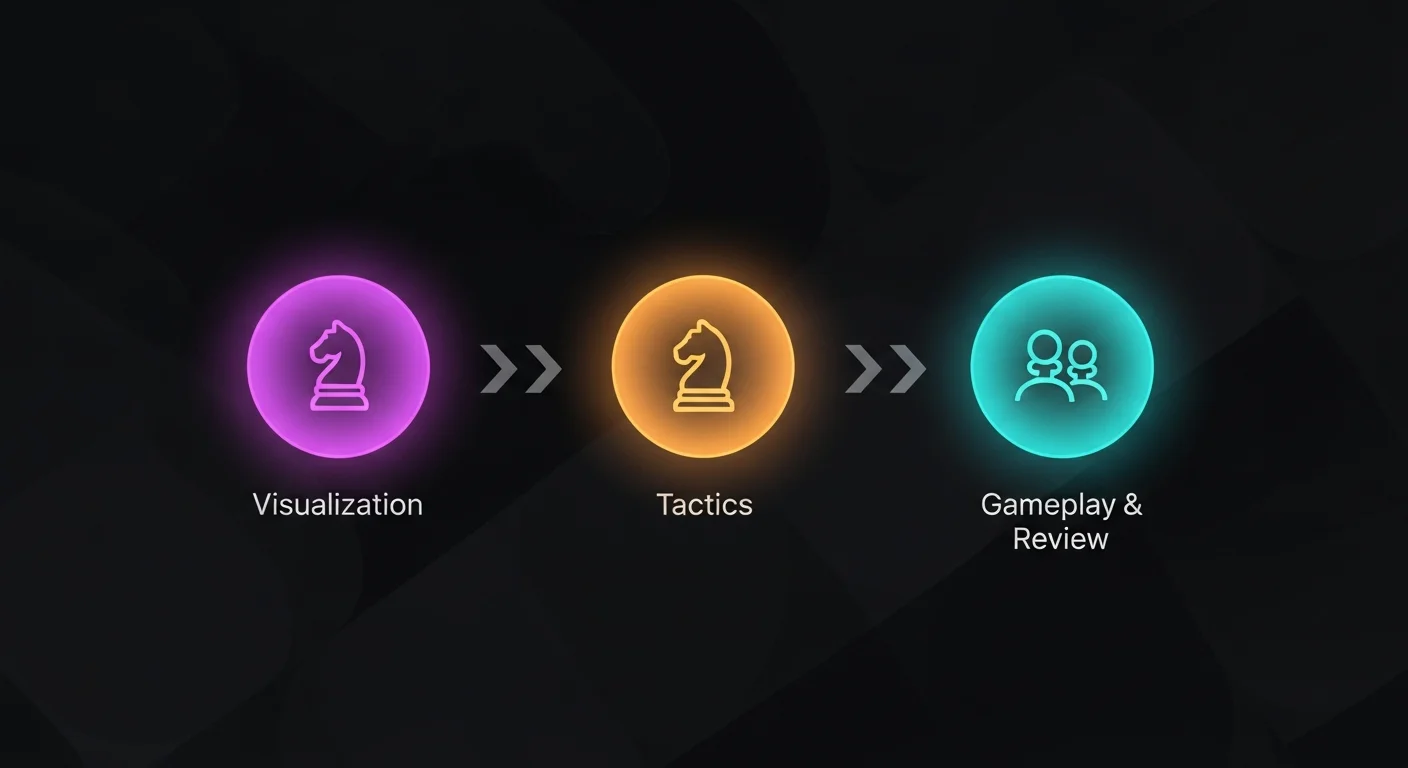
Monday | Visualization | 30 minutes | Board recall exercises, single-piece movement patterns |
Wednesday | Tactics | 35 minutes | Blindfolded puzzle solving, starting with 2-move combinations |
Friday | Game play | 40 minutes | One full blindfold game against software or partner |
Sunday | Review | 25 minutes | Analyze previous games, identify recurring visualization errors |
This plan provides roughly 2.5 hours across four sessions. Notice the rest days between sessions. They are when learning consolidates, not optional extras.
Progression milestones and adjustments
Track progress with clear metrics. How many moves can you visualize before losing the position? How fast do you solve blindfold tactics? What is your accuracy in full games?
Structured practice can reduce solving times for blindfold tactics by about 31%. Trainees using systematic plans also showed a 26% average Rapid rating increase versus irregular practice.
Assess every two weeks. If exercises feel routine, increase complexity. Add pieces to drills, extend tactical sequences, or face stronger opponents.
If frustration persists or errors repeat, dial back. Master fundamentals before advancing. World Blind Chess Champion Marcin Tazbir, rated 2234 FIDE, perfected basic visualization for years before complex endgames.
Build flexibility for disruptions. Missing a session occasionally will not derail progress. Skip more than two weeks, and restart slightly easier to rebuild connections.
Your regimen should feel sustainable for months. If it becomes stressful, adjust it. Consistency beats perfection in skill development.
To complement your blindfold chess training, consider dedicated visualization exercises that accelerate progress.
Developing visualization skills for blindfold chess
Visualization is not mystical. It is a trainable skill like endgame technique. Most players who struggle do not lack hardware, they lack the right sequence of practice.
Your brain can build and manipulate a mental chessboard. It just needs structured exposure. Think of it like learning a language that feels awkward at first, then natural.
Start with static positions to build board memory. Set up five pieces on a physical board. Study for thirty seconds, then close your eyes.
Can you reconstruct the position mentally? Which squares hold which pieces? If it feels fuzzy, that is normal. Open your eyes, check accuracy, and repeat. This observe, recall, and verify cycle builds visual working memory.
Once static recall is reliable, introduce motion. Set a position, then plan one move before touching the pieces. Visualize the change completely, then execute and verify.
This single-move preview trains anticipation. Gradually move to two moves, then three, always checking mental accuracy against reality.
Develop fluent board coordinates. Spend five minutes daily on square drills. Name neighbors instantly, and relate two squares by color, diagonal, or rank.
Use familiar openings to reduce cognitive load during early drills. Familiarity lets you focus on imagery rather than deciphering unfamiliar structures.
Grandmaster Jonathan Tisdall credits blindfold training for his title, noting it was instrumental. The transfer is real. When you hold complex positions mentally, calculation sharpens at the physical board.
Replay master games without a board for powerful training. After each move pair, pause and test your mental position. If you lose track, rewind a few moves, not the entire game.
Visualization Exercise | Skill Developed | Recommended Frequency |
|---|---|---|
Static position recall | Chess board memory | Daily, 10 minutes |
Single-move prediction | Dynamic visualization | Every practice session |
Coordinate drills | Square recognition speed | Daily, 5 minutes |
Master game replay | Position retention over time | 3-4 times weekly |
Incremental progress matters most. Holding five-piece positions this week and seven-piece positions next month is real growth. Track your accuracy percentage after thirty seconds.
Let that number climb steadily. Do not add complexity before mastering simpler positions. A strong foundation prevents frustration when you attempt full blindfold games.
Repetition builds durable pathways. The board that once required strain will soon appear as naturally as your childhood home. You are not forcing an image, you are recalling a known space.
This familiarity comes from hours of practice, not innate gifts. Sessions that feel difficult are building the exact circuits you need. Discomfort signals learning.
For faster gains, consider structured chess visualization training with exercises tailored to blindfold demands.
Incorporating cognitive exercises into training
Blindfold chess relies on broader cognitive skills that you can train deliberately. Think of these activities as strength work that supports your marathon.
Memory games improve information retention and pattern recognition. When you visualize a position later, those same pathways help reconstruct the board quickly and accurately.
Spatial puzzles offer another strong complement. Mental rotation tasks and tangram-style challenges build the spatial reasoning behind diagonal moves and knight jumps. They feel different from chess yet train the same flexibility needed for multi-move calculation.
Use memory palaces to organize board information. Associate squares with locations in your home to create vivid anchors for faster recall.
Concentration drills target sustained focus, a major blindfold challenge. Counting backward by sevens or tracking multiple moving objects builds attentional control that prevents mid-game drift.
Working memory tasks deserve special attention. N-back and sequence tracking train your ability to juggle information. This capacity is crucial when updating piece locations while exploring variations.
Exercise Type | Cognitive Benefit | Chess Application | Weekly Time Investment |
|---|---|---|---|
Memory games (card matching, sequence recall) | Pattern recognition and information retention | Faster position reconstruction and piece recall | 15-20 minutes, 3x weekly |
Spatial puzzles (mental rotation, 3D manipulation) | Spatial reasoning and mental flexibility | Improved visualization of diagonal moves and knight jumps | 20 minutes, 2x weekly |
Concentration drills (dual-task training, focus exercises) | Sustained attention and cognitive control | Maintaining position awareness during long calculations | 10 minutes daily |
Working memory tasks (n-back, sequence tracking) | Information juggling capacity | Managing multiple variations simultaneously | 15 minutes, 3x weekly |
Dual-task training is especially helpful before tournaments. Practice visualization while maintaining a running count or tracking changing information. This simulates pressure and teaches efficient mental resource allocation.
Apply progressive overload to these drills. As exercises become easy, add complexity or switch to demanding variants. Improvement should be noticeable within two weeks.
Timing matters. Use cognitive drills as warm-ups before blindfold sessions, or as active recovery on lighter days. They keep your edge without the fatigue of full visualization work.
"The strongest blindfold players are cognitive athletes who expertly process and manipulate information."
Research supports integration. Players who combine cognitive work with chess-specific training improve more than those who practice chess alone. The 31% reduction in blindfold solving times reflects both chess growth and enhanced cognition.
Do not underestimate small daily doses. Five to ten targeted minutes compound over months. You are building infrastructure that lifts blindfold play and overall chess strength.
For a comprehensive approach, specialized chess memory training offers structured exercises that bridge general cognition and chess application.
Tracking progress and adjusting the regimen
You will not improve what you do not measure. Many train for weeks without data, then feel stuck.
Start with baselines before structured work. Time how long you need to visualize a simple position. Record how many moves you can calculate without a board.
Keep a training journal. After each session, note what you practiced, how it felt, and which positions caused trouble. Patterns will reveal where visualization breaks down.
Simple metrics that matter
Track three numbers weekly: puzzle time, accuracy percentage, and maximum calculation depth.
Review performance every two weeks. Compare current metrics with your baselines. Trainees often achieve a 31% reduction in solving times for blindfolded tactics after consistent practice. If numbers stagnate, adjust the plan.
Set achievable goals to avoid frustration. Break ambitions into monthly milestones. If a full blindfold game in six months is your aim, target eight-move sequences this month.
Timeline | Realistic Goal | What Success Looks Like |
|---|---|---|
Week 1-2 | Board familiarity | Name any square in under 2 seconds |
Week 3-4 | Piece tracking | Follow three pieces through five moves |
Week 5-8 | Position retention | Recreate a middlegame position after 30 seconds |
Week 9-12 | Short games | Complete a 10-move blindfold game |
Adapt the schedule as needed. Some weeks you will exceed targets. Other weeks you will struggle with familiar drills. Both require a response.
When progress is fast, raise difficulty gradually. Add pieces to visual drills or extend sequences by two moves. Push, but avoid sudden jumps to advanced material.
Plateaus are normal. Metrics may stall for weeks while your brain consolidates. Keep training patiently through these periods.
Use setbacks as feedback. A stressful week that lowers accuracy highlights the role of stress management. Losing track in complex positions signals a need for structured scanning practice.
The same research reporting solving gains also found a 26% average increase in Rapid FIDE Elo ratings versus control groups. Those gains came from consistent adaptation, not rigid plans.
Motivation will fluctuate. Build habits that reduce reliance on willpower. Tie blindfold practice to existing routines, such as after regular study or during morning coffee.
Celebrate small wins in your journal. Navigating a complex blindfold tactic or a new personal best for depth deserves recognition. Positive reinforcement fuels consistency.
Run monthly assessments for objectivity. Play a blindfold game against a known-strength opponent, or solve a fresh tactics set. Compare results with prior months to gauge improvement.
External accountability helps some players. Share goals and metrics with a coach or partner. They notice patterns you might miss. For structured support, structured chess visualization training aligns well with blindfold practice.
Let your regimen evolve with your skills. Beginners need more orientation work. Intermediate players focus on position retention. Advanced players can prioritize blindfold game analysis and review.
Progress will not be linear. You might surge, then plateau. Maintain consistent practice and adapt using real data. That is how long-term gains accumulate.
Taking the next step: Competitive play
You have built blindfold skills systematically. Now test them against real opponents. Competition turns training into a practical weapon.
Start small online. Platforms like Chess.com and Lichess support blindfold mode for rated games. Choose longer time controls, such as 15+10 or 30+0, to visualize without panic. The stakes are lower than face-to-face events, yet you feel real time pressure.
After gaining confidence, try local blindfold events. Many clubs run small tournaments, including inclusive formats for visually impaired players. These communities include experts who learned the skill by necessity and share valuable insights.
Two weeks before competition, shift about 60% of training to timed blindfold games. Practice managing clock pressure while maintaining position accuracy.
Competitive play reveals gaps that solo practice hides. You may memorize well but falter against unexpected moves. Under tournament conditions, there is no pause to double-check your mental board. Repeated exposure builds trust in your visualization.
Track a blindfold rating separate from your sighted rating. Many players begin 200 to 300 points lower. The gap narrows as visualization becomes second nature. Players like Marcin Tazbir, the World Blind Chess Champion with a FIDE rating of 2234, show how far dedicated practice can go.
Competition Level | Recommended Experience | Typical Time Control |
|---|---|---|
Online casual | 3+ months consistent training | 15+10 or longer |
Local club events | 6+ months with metrics tracking | 30+0 or 45+45 |
Regional tournaments | 1+ year, sub-10% error rate | Classical time controls |
Do not wait to feel perfectly ready. Set a threshold. When you can play three blindfold games with fewer than five square errors each, enter an event. Real opponents teach lessons drills cannot.
Between tournaments, analyze competitive games like training sessions. Where did you lose track? Which surprises broke your model? Use those insights to refine practice, whether pawn structures or sharp tactical lines.
Competition also builds mental stamina. A tournament might require four blindfold games in a day. Sustained concentration like this differs from 20-minute drills and develops lasting endurance.
"The board disappears when you stop treating blindfold chess as memorization and start seeing it as pure chess thinking."
Competitive blindfold play strengthens overall chess. After tracking 32 invisible pieces, calculating three visible moves feels easier. Your next step is simple. Schedule one blindfold game against a real opponent this week, online or over-the-board. Set a timer, play seriously, and record the result in your training log. Then adjust next week’s practice based on what you learned.
Frequently Asked Questions
Last updated: Feb 24, 2026

Antoine Tamano
Angers France
I’m Antoine Tamano, founder of Instablog — a tool that helps businesses turn existing website content into a consistent, SEO-friendly blog. After working with startups and larger companies, I saw how hard it was to keep up with blogging, even when the value was clear. Instablog was born from a simple idea: make blogging easier using what’s already there. Here, I share what I’ve learned building Instablog and why smart content should be core to any growth strategy.


