
Chess Conceptualization Model: Pawn Structures & Strategy
Antoine Tamano11 min read
Table of contents
Most players improve slowly because they accumulate chess knowledge without organizing it. They memorize opening lines without grasping the plans behind them. They study tactics without recognizing the structural triggers that make them possible. A chess conceptualization model solves this: a personal mental framework, anchored in pawn structures, that maps how chess knowledge connects, so you recognize patterns faster, find plans more reliably, and make better decisions under time pressure. The structural recall behind it sits inside our broader chess visualization training hub.
Disclosure: DarkSquares is our product. We mention it where relevant to the topic. Readers should weigh our perspective accordingly.
What is a chess conceptualization model?
A chess conceptualization model is the internal structure you build to organize your chess understanding around your opening repertoire. Instead of storing isolated facts, it maps relationships: how a certain pawn structure dictates piece placement, which tactical motifs arise from specific configurations, and what your pieces need to accomplish in each phase of the game.
Think of the difference between a list of street names and a road map. A list is just data. A road map shows how everything connects, so you can navigate to any destination, even one you have never visited. Your chess model works the same way: once the structural relationships are internalized, you can find reasonable plans in positions you have never seen before.
Renowned trainer Mark Dvoretsky, an International Master and FIDE Senior Trainer who coached several world-class grandmasters, emphasized this throughout his career: understanding the why behind moves builds judgment that works in new positions. Memorized lines break down at move 15; a strong conceptual model keeps working through every phase of the game.
Why memorization alone fails
The central problem with pure memorization is that positions diverge. Your opponent plays something unexpected on move 8, and suddenly twenty memorized moves become useless. Players without a conceptual model freeze, they have knowledge but no framework to deploy it.
This explains why club players who "know" the Sicilian Najdorf still blunder in the middlegame. They learned moves without learning the model behind them: that Black typically targets queenside counterplay with b5 and a5 in various lines, that the e4-square can become a key outpost for Black's pieces in English Attack structures, and that the d5 break transforms the character of the entire position when it can be safely executed.
Research in the classic chess-cognition literature, starting with Chase and Simon's 1973 "Perception in Chess" study and its successors reviewed in this NIH-hosted review, confirms that masters encode positions as meaningful patterns and plans, not as individual piece locations. Building a conceptualization model trains exactly this skill, and it is trainable at any level.
The three pillars: pawn structure, piece activity, king safety
Every chess conceptualization model rests on three concrete pillars. These are not vague principles to recite, they are the lenses you apply to every single position you encounter.
Pawn structure
Pawns are almost permanent. Unlike pieces, they cannot retreat. Understanding your pawn structure tells you which squares will be permanently weak, which files will open, and what the endgame is likely to look like. In the French Defense, White's space advantage on the kingside and Black's counterplay on the queenside both flow directly from the pawn structure that arises after e6, d5, and e5. Players who understand this do not need to memorize French theory, they can reconstruct correct plans from structural logic.
Piece activity
A piece's value depends entirely on the quality of squares it can reach and the targets it can attack. The "bad bishop," locked behind its own pawns with no targets, is one of chess's most instructive concepts precisely because it shows how dramatically structure affects piece value. Build your model around maximizing piece activity: find the outposts, open the right files, and coordinate pieces toward the opponent's structural weaknesses.
King safety
King safety is asymmetric and time-sensitive. You can sometimes ignore your own king while attacking the opponent's, but the moment your king is exposed, every material advantage becomes secondary. Your conceptualization model must constantly evaluate: how vulnerable is each king, and how many moves does the opponent need to generate real threats? Correct assessment here often overrules all other factors.
Building your model: a step-by-step approach

Building a chess conceptualization model takes consistent effort but follows a clear structure. Work through these five steps to create a personal framework that grows stronger with every game, and pair them with our guide to chess conceptualization training for the drills that make the framework automatic.
Step 1: Anchor your model to your opening structures
Your model starts with the pawn structures you actually play. Pick two or three structures on each color and study them deeply: typical plans, ideal piece placements, characteristic pawn breaks, and common endgames. This creates your core vocabulary.
For example, if you play the Queen's Gambit Declined as Black, your model should include: the c5 break to challenge White's center, the Lasker Defense with Ne4 to exchange a pair of minor pieces and ease Black's position, and the minority-attack defenses when White plays Carlsbad structures. These are not moves to memorize, they are recurring structural ideas to recognize on sight.
Step 2: Map tactical motifs to pawn structures
Every pawn structure generates recurring tactical patterns. In positions with an isolated d-pawn, the d5 outpost enables a recurring Nd5 or Nd4 sacrifice theme. In the Sicilian Dragon, the opposite-side-castling h-file attack reappears across dozens of different move orders because the structure itself creates the attacking blueprint.
Write down five tactical motifs that arise in your typical structures. When that structure appears in a game, these motifs become your first checklist before calculating concrete lines.
Step 3: Connect structures to endgames
Every middlegame leads somewhere. Your model should include the typical endgames your structures produce. If you play the Carlsbad structure (White pawns on c3, d4 against Black's c6, d5), know the queenside minority attack for White, the central outpost plan for Black with Ne4, and the typical rook endgame conversions when the minor pieces come off.
Step 4: Annotate games by structure, not by moves
When analyzing your games, start with the pawn structure that arose. Ask: what plan was correct here? Which pieces should have been exchanged? Where were the key squares? Only after answering these structural questions should you calculate specific variations. The DarkSquares famous games trainer is a ready source of annotated structures you can drill daily.
This habit builds the model instead of just cataloging lines. After three months of structure-first annotation, you will recognize the correct plan faster, even in positions you have never encountered before.
Step 5: Test your model under pressure
A conceptualization model only works if it is accessible under time pressure. Use blindfold training to force abstract thinking: without visual pieces to lean on, you must rely on your structural understanding alone. Start with your best-known structures, and you will discover quickly whether the model is truly internalized or just memorized. Supplement with reps in the DarkSquares position memory trainer, where structural recall is tested without piece icons to lean on.
Core pawn structures every club player should know
Before expanding your library, anchor the classics. Carlsbad, IQP (Isolated Queen's Pawn), French chain, QGD, Sicilian Dragon, and Najdorf form the backbone of most club-level repertoires. Each has a stable plan library, typical piece placements, and recurring endgames.
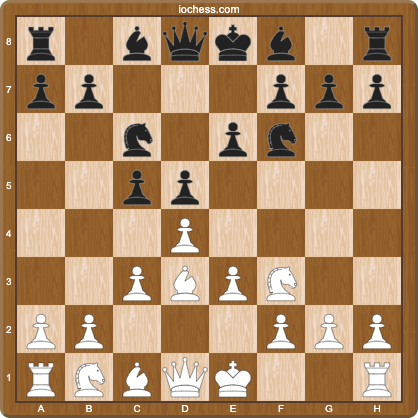
Additional pawn structures every club player should know
Once the core structures feel automatic, add these five to broaden your model. Each creates a distinct strategic conversation, and recognizing them on sight unlocks entire game plans.
Hanging pawns
Hanging pawns are an isolated duo, typically c4 and d4 (or c5 and d5 for Black), unsupported by neighboring pawns. They are dynamic: strong when supported by active pieces and ready to advance, weak when they become static targets. Karpov–Kasparov games from their long world-championship rivalry repeatedly featured both sides demonstrating the tension between attack and blockade in such structures. Your plans center on advancing c5 or d5 to open files, while the opponent tries to fix the pawns and pile pieces on them.
Stonewall
The Stonewall places White pawns on c3, d4, e3, and f4 (mirror for Black: c6, d5, e6, f5). It is a closed structure with a permanent light-square weakness: the e4 square becomes a hole that the opponent occupies as an outpost, and the light-squared bishop (c1 for White, c8 for Black) is the chronically bad piece. The typical plan is a kingside attack supported by the f-pawn and a knight coming to e5 (or e4 for Black). Piece activity centers on the fianchettoed bishop and the outpost square. Weakness: the c8 to h3 diagonal for White often stays fragile.
Benoni
Benoni structures arise when White has a pawn on d5 and Black has pawns on d6, e6, and c5. The result is asymmetric and counterattacking: Black concedes space but gains dynamic piece play on the queenside with b5 and counterplay against White's center. White's plan is to restrain b5, maintain the d5 wedge, and break with e5 at the right moment. Black's trumps are the half-open e-file and the dark-square complex around d4 once White overextends.
Maróczy Bind
The Maróczy Bind is a space-binding formation with White pawns on c4 and e4 against a Sicilian structure. It restricts Black's d5 break and cramps the pieces. White's plan is long-term: trade Black's active pieces, keep the bind, and drive home the space edge in the endgame. Black's counterplay leans on Nd7 to e5, pressure on c4, and the well-timed b5 break. Understanding the bind is essential against Accelerated Dragons and English-type setups.
Hedgehog
The Hedgehog is a restrained Black setup with pawns on a6, b6, d6, and e6, and pieces coiled behind the lines. It looks passive but is packed with latent counterplay. Black waits for White to overextend, then strikes with b5 or d5 at the right moment. Knowing the Hedgehog teaches patience, because the structure rewards waiting moves and punishes premature aggression from the stronger side.
Applying your model in real games
Your conceptualization model gives you three tools at any point in a game: a checklist, a direction, and a fallback. The checklist runs through your three pillars: pawn structure, piece activity, king safety. The direction is the plan your structural knowledge points toward. The fallback is the simple, structure-consistent move when you are short on time.
Many players report a real breakthrough when they stop asking "what is the best move?" and start asking "what does this structure want?" The second question is always answerable from your model, even in unfamiliar territory. The first question often leads to analysis paralysis.
To build the underlying cognitive skill, accelerate progress with the DarkSquares chess visualization training path, exercises designed around board geometry and square awareness that free up the mental bandwidth your model needs. Over time, the model becomes automatic, and your chess thinking shifts from effortful calculation to confident, pattern-driven decision-making. If you want these drills paired with a weekly plan, the DarkSquares pricing page maps each tier to a training schedule.
Conclusion: what you have built
After working through these steps, you should have: two to three well-understood pawn structures per color, a written list of tactical motifs tied to each structure, a map from middlegame structures to typical endgames, and the habit of annotating games structure-first. That is a working chess conceptualization model, the same type of framework strong players use, compressed into a form you can keep building for the rest of your chess life.
- Anchor your model to two or three pawn structures and map plans, motifs, and endgames for each.
- Annotate games structure-first: what plan was correct, which pieces to trade, where the key squares were.
- Connect tactical motifs to structures: know the recurring sacrifices and breaks your structures enable.
- Expand into hanging pawns, Stonewall, Benoni, Maróczy, and Hedgehog once the core structures feel automatic.
- Test your model under blindfold conditions where abstract thinking is the only tool available.
Start today: Pick one position from your last game and write down the pawn structure, the correct plan for that structure, and one tactical motif it enables. That is your first model entry.
Related reading
- Chess Visualization Training: From 1200 to 2000
- Mastering Endgames: Solutions and Strategies
- Simplify Chess Calculations: Think Clearly Under Pressure
Sources
Frequently Asked Questions
How long does it take to internalize a chess conceptualization model?
Building a working model around two or three pawn structures takes most club players 8 to 12 weeks of structure-first game annotation. Recognition becomes fast (under 5 seconds) for the structures you actively study; novel structures will still slow you down. The model deepens for years, but at 3 months you should already feel the difference: less analysis paralysis on quiet positions, faster correct plans in unfamiliar middlegames.
Should I learn pawn structures before or after tactics?
Tactics first, structures second. Pattern recognition for forks, pins, skewers, and back-rank mates underwrites every structural plan; without it, you cannot execute the breakthrough your structure suggests. Once you reach roughly 1400 Elo with reliable tactics, pivot to structures: that is when memorized openings start failing and conceptual understanding pays back fastest.
Which pawn structures should a 1200 to 1500 player learn first?
Start with three: the Carlsbad (QGD/Slav universe), the Isolated Queen's Pawn, and the French chain. Together they cover most queen's-pawn and 1.e4 e6 games at club level, and each has a small library of stable plans you can drill in 2 to 3 weeks. Add the Sicilian Najdorf and Dragon structures only if you actually play them.
Can I build a conceptualization model without studying classic master games?
No. Master games are the source of structural patterns; modern engine analyses do not replace them because engines find moves but rarely articulate why a structure favors one side. Spend 2 hours per week on a 1900s to 1990s master game in your structures, annotated by a strong player. The DarkSquares <a href="https://darksquares.net/train/famous-games" rel="noopener noreferrer" target="_blank">famous games trainer</a> sequences this exposure.
How is a conceptualization model different from an opening repertoire?
An opening repertoire is the move list you play through move 12. A conceptualization model is the network of plans, motifs, and endgames the resulting structures produce. Repertoires break when opponents deviate; models keep working because they describe the position, not the moves. Build the model around the structures your repertoire reaches, and your repertoire becomes 10x more resilient to surprises.
Last updated
Related Articles
Is Chess Good for Your Brain? What the Science Actually Says
Short answer: yes, chess is a genuine mental workout, but the popular version of the claim is overhyped. Playing chess reliably trains a cluster of do…
Antoine · 7 min read

Is Being Good at Chess a Sign of Intelligence?
Short answer: only partly. Being good at chess correlates modestly with general cognitive ability, but the link is far weaker than most people assume.…
Antoine · 6 min read

How to Train Chess Visualization: Pick the Right Trainer and Plan
Most club players lose the position after 2–3 moves when calculating, then blunder under pressure. You can change that in 4–8 weeks with a focused rou…
Antoine · 10 min read