
Most chess players see only the current board. Masters see what could appear three, five, even ten moves ahead. That gap is visualization, the skill that turns guesswork into accurate calculation. You will learn how visualization can enhance your chess game with practical methods that sharpen calculation, strategic planning, and confidence under pressure.
Understanding the role of visualization in chess
Visualization in chess means seeing positions, moves, and variations in your mind without moving a piece. When you calculate or plan, you simulate future boards. This is not imagination. It is a structured process where your brain maintains an internal map of pieces, squares, and relationships.
GM Igor Smirnov puts it simply:
Chess visualization is about your ability to see different moves and variations in your mind without moving the pieces... If you cannot see the position accurately while calculating, you will make miscalculations.
That accuracy matters more than depth. Garry Kasparov warns: "It doesn't matter how far ahead you see if you don't understand what you are looking at."
Watch strong players think and the role of visualization becomes clear. They do not calculate every sequence. David Norwood notes that
Grandmasters do not do an inordinate amount of calculating... chess skill often seems to reflect the ability to avoid calculations.
Master players excel at simplifying calculations in chess by breaking complex positions into manageable chunks. They use visualization to filter lines, quickly read key features, and follow only promising paths.
Consider opening strategy. According to database analysis, the Caro-Kann is noted for its strategic depth and effectiveness in certain high-level chess contexts, while the Sicilian Defense remains a popular choice among players. The gap reflects more than theory. It reflects how well players visualize the middlegame structures those openings produce.
Strong visualization improves every phase. In tactics, you spot forks, pins, and skewers before they appear. In strategy, you judge whether a pawn break weakens or activates your pieces. Under time pressure, you avoid blunders by maintaining a clear mental board. Players who develop this skill train their brains to hold complex positions, making calculations reliable and plans coherent.
The process follows a cycle. First, encode the position, noting pieces, pawn structure, and key squares. Then simulate moves, updating your mental board after each change. Finally, evaluate the result for material, safety, and activity. Errors arise from weak encoding, faulty simulation, or poor evaluation. These skills are enhanced by understanding memory techniques for chess visualization, which provide structured methods for encoding and retrieving positions.
Mastering visualization does not require photographic memory. It requires steady practice that builds accurate mental images. The gap between club players and masters often hinges on reliably seeing four or five moves ahead, not on calculating twenty.
Techniques to develop visualization skills
Structured training builds strong visualization. For a complete progression system, follow our guide on improving chess visualization skills that takes you from fundamentals to advanced board vision. Targeted drills isolate board reconstruction, piece tracking, and pattern recognition under load.
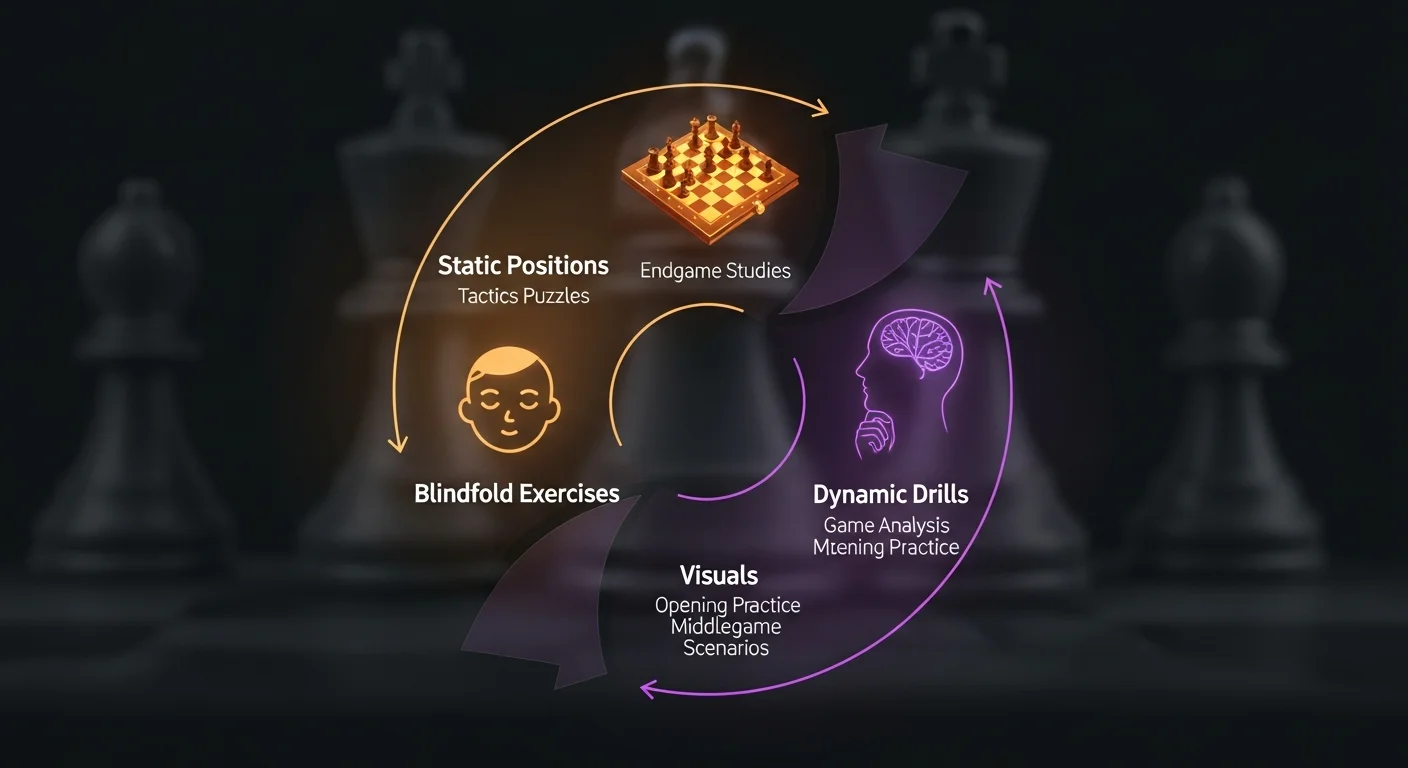
Start with static positions. Set up a middlegame with 15 to 20 pieces, study for 30 seconds, then hide the board. Reconstruct it on a blank diagram or recite every piece's square. Compare to the original and note neglected sectors.
Once you reach 80% accuracy, add motion. Play a short tactical line on the board, then replay it mentally with the board hidden. Speak each move aloud. This forces accurate simulation and exposes illegal moves.
Learning blindfold chess pushes intensity. Aiden Rainer says: "For rapid improvement, we must isolate and intensify our target skills... train visualization at an intensity higher than in an actual game." Even short blindfold games force precise encoding and simulation.
Begin blindfold work with mate-in-two puzzles. A partner reads, "White king g1, rooks a1 and f1; black king h8, pawns g7 and h7." Solve without seeing the board. Progress to mate-in-three, then simple endgames, before full games.
Audio-Only Training
Once a week, remove the board. Have a partner read positions while you solve mentally; Quality beats volume.
Use dynamic drills. Calculate a five-move sequence from a set position, then reconstruct the final position on another board without peeking. Strong players typically achieve high accuracy, while lower accuracy may indicate unrealistic expectations.
Add distractions. Calculate while listening to commentary or music with lyrics. Start with three-move sequences, then extend as accuracy holds. Tournament halls are noisy. Train for it.
Track specific errors. Forget a piece existed, misread a knight's reach, or lose pawn structure after trades. Each error points to a fix. Drill static reconstruction, knight-only puzzles, or slower verbal updates, respectively.
Time constraints make visualization a weapon. Titled Tuesday on Chess.com continues to attract large numbers of players to its fast time controls. You cannot calculate piece by piece. You need pattern chunks that compress familiar configurations.
Build speed with intervals. Use a timer: 30 seconds for two-move puzzles, 60 for three. Track accuracy and time. If accuracy dips below 70%, slow down and rebuild precision before pushing speed.
Combine methods in one session. Spend 15 minutes on reconstruction, 15 on blindfold mates, and 15 on timed tactics. Avoid siloed skills. Strong players think smoothly in games because their training connects.
Applying visualization to improve game tactics
Tactics pop when you can hold positions clearly. A fork is obvious when you see where your knight lands and what it hits. A pin appears when you project the diagonal and notice frozen pieces. Faster calculation follows from pattern recognition supported by clean visualization.
Start with single-move tactics. Find a simple fork. Close your eyes, count the knight jumps to the target square, and list attacked pieces. Confirm only after you are sure. This builds trust in your internal board.
Be specific. Do not think "the bishop pins the knight." See the path from f4 to c7, a knight stuck on e6, and a king on d8. Count and name the squares. Precision makes calculation reliable.
Fischer vs. Spassky, 1972 Game 6, shows this power. In a deep positional masterpiece with no piece sacrifice, Fischer outplayed Spassky with quiet, strategic moves and evaluated a rook endgame many moves away. He tracked pawn structures, king routes, and tempi across variations. Spectators could not see it. He could, because he trained forward projection.
Practice fork patterns with all pieces. Visualize a knight on f7 forking the king on g8 and the queen on d8. Picture a queen from e4 targeting a8 and h7. Then reverse it. Given targets, find which piece and square create the fork.
Tactical Reconstruction Drill
Study a tactical position for 30 seconds, clear the board, rebuild it from memory, then visualize and state the winning line with eyes closed.
Pins require tracking three elements: attacker, pinned piece, and the valuable piece behind. See a bishop on b2 pinning a knight on e5 to a king on h8. Add a pawn to f4, and the knight collapses. Layer static pins with dynamic follow-ups.
Skewers reverse the priority. The valuable piece moves first, exposing the lesser piece. Picture a rook on a1, a queen on a5, a bishop on a7. The rook checks, the queen flees, the bishop drops. Drill files and diagonals until the geometry becomes automatic.
Discovered attacks demand multi-thread tracking. A knight from e5 hops to f7, revealing a bishop from d4 striking h8. Hold the current setup, the knight's destination, and the opened line at once. Training chess visualization skills with multi-change exercises builds stamina for complex tactics.
Study master games for tactical moments. Pause before critical shots and guess what the player saw. Kasparov's games against Topalov and Anand contain deep tactical trees. Ask which pieces required tracking, how far ahead he calculated, and which lines he rejected.
Combine patterns in training. Build positions with a fork, a pin, and a back-rank weakness. Practice seeing all threats without moving pieces. Real games present overlapping ideas, so your visualization must cover the entire tactical picture.
Use blindfold tactics. Solve mate-in-two problems without pieces. Call moves in notation, visualize the result, then judge threats. Start with few pieces, then add complexity.
Time yourself, but protect accuracy. A correct three-move tactic in 90 seconds beats a wrong answer in 30. Speed rises naturally as patterns become familiar.
Test with double-check problems. See two attackers giving check at once, such as a knight from f6 and a bishop from c4 hitting e8. Track both lines and the king's escapes. This trains the same skills you need for hard tournament tactics.
Common challenges and misconceptions
Most players starting chess visualization training quit within two weeks. They expect instant gains and misread slow starts as fixed limits.
Early attempts feel clumsy. A three-square knight hop might take 15 seconds at first. After a month of daily practice, it takes under a second. Compare to last week, not to grandmasters.
Many believe visualization is innate. It is trainable. Chess visualization challenges respond to targeted repetition, just like coordination drills. With steady work, beginners can advance from three to ten moves in months.
Another misconception concerns grandmasters. They do not visualize every move from start to finish. They recognize patterns instantly and calculate only critical branches deeply.
The Two-Move Wall
Many stall after seeing the opponent's reply. Force exactly three-move calculations each day, and the image stabilizes within weeks.
A frequent trap is practicing beside a board. It becomes a crutch. Train without visual aids. Work through positions while walking, commuting, or lying in bed with eyes closed.
Fatigue also matters. Intensive blindfold work burns cognitive energy. After 30 minutes, accuracy drops. Short sessions of 15 to 20 minutes with breaks build skill faster.
Forget the myth of perfect clarity. Even grandmasters track only relevant lines. A rook on a1 checking a king on h1 does not require visualizing every square, only confirming no blocks.
Complexity often is not the problem. Piece tracking is. Use positions with many identical pieces to force precise indexing. Three white knights and three black knights sharpen location memory.
Do not avoid learning blindfold techniques. Starting early cleans up habits and accelerates overall improvement.
Integrating visualization practice into your daily routine
Structure separates strong visualizers from the rest. Random practice yields random results. A routine built around daily visualization creates habits that carry into tournaments.
Start with five minutes each morning before touching a board. Picture a simple position, place the pieces, and calculate one variation. Mornings are ideal for building new neural pathways.
Turn downtime into training. Study a position for 30 seconds on your phone, then close your eyes and reconstruct it. Lichess and Chess.com make setups quick.
Track what you train. Log position types and accuracy. A simple spreadsheet with date, description, and success rate makes progress visible.
Schedule three sessions: morning calculation, midday reconstruction, and evening review without moving pieces. Spaced practice strengthens retention better than one long block.
Use digital boards for immediate feedback. Hide the position, rebuild from memory, then verify. Fast feedback stops errors from hardening.
Anchor practice to routines. Review a tactic while coffee brews. Reconstruct a master position at lunch. Consistency beats duration.
Take rest days. Practice six days, rest one. Sleep and downtime consolidate patterns. Skipping rest leads to diminishing returns.
Protect focus. Five minutes of deep work beats 30 minutes of scanning. Silence notifications and give each position full attention.
Start tonight with one move from a recent game. Tomorrow, visualize two moves, then add a move each day until you reach ten. Within a month, long variations feel natural. Set a five-minute timer now, then schedule two more five-minute sessions for tomorrow. For a plan to follow, see structured visualization training.
Frequently Asked Questions
Last updated: Apr 10, 2026


