Chess Coordinates: a1 to h8 Explained
How to read any square, and a free drill to make it instant
Updated
Chess coordinates name every square with a file letter and a rank number, file first. The files run a to h from left to right on White's side, the ranks run 1 to 8 from White's side to Black's. So e4 is the e-file on the fourth rank, a1 is White's bottom-left corner (a dark square) and h8 is the opposite corner.
Knowing the rule takes a minute; reading squares without thinking takes practice. The free coordinate trainer shows a square name and you tap that square, as many as you can in 60 seconds, from White's or Black's side, with no signup. The rest of this page explains the grid in detail and how to train it.
What is chess coordinate training?
Coordinate training is short, repeatable practice on the structure of the board. The 64 squares have unique names from a1 to h8. You learn to name any square on sight, recall its color, and recognize which other squares share its file, rank, or diagonal. The drills are deliberately small, because the goal is automaticity, not deliberation.
A trained player can answer "is f6 light or dark?" in under a second. An untrained player has to count from a corner, which uses working memory you would rather spend on the position. That is the gap coordinate training closes.
The chess board coordinates system: a1 to h8
Every square on a chess board has a unique coordinate built from two parts: a file letter and a rank number. The eight files run a to h, left to right from White's side of the board. The eight ranks run 1 to 8, bottom to top from White's side. Combine them and you can name all 64 squares, from a1 in White's bottom-left corner to h8 in the top-right corner from White's view.
Reading chess board coordinates always follows the same order: file first, rank second. e4 is the e-file, fourth rank; a knight on g1 sits on the g-file, first rank. On a correctly oriented board the bottom-left square (a1) is always dark, and White's queen starts on d1, a light square.
- Files (columns): a, b, c, d, e, f, g, h, left to right from White's side
- Ranks (rows): 1 through 8, nearest White up to nearest Black
- Any square is file then rank: a1 is White's bottom-left corner, h8 the top-right corner from White's view
- White's back rank is rank 1 (a1 to h1); Black's back rank is rank 8 (a8 to h8)
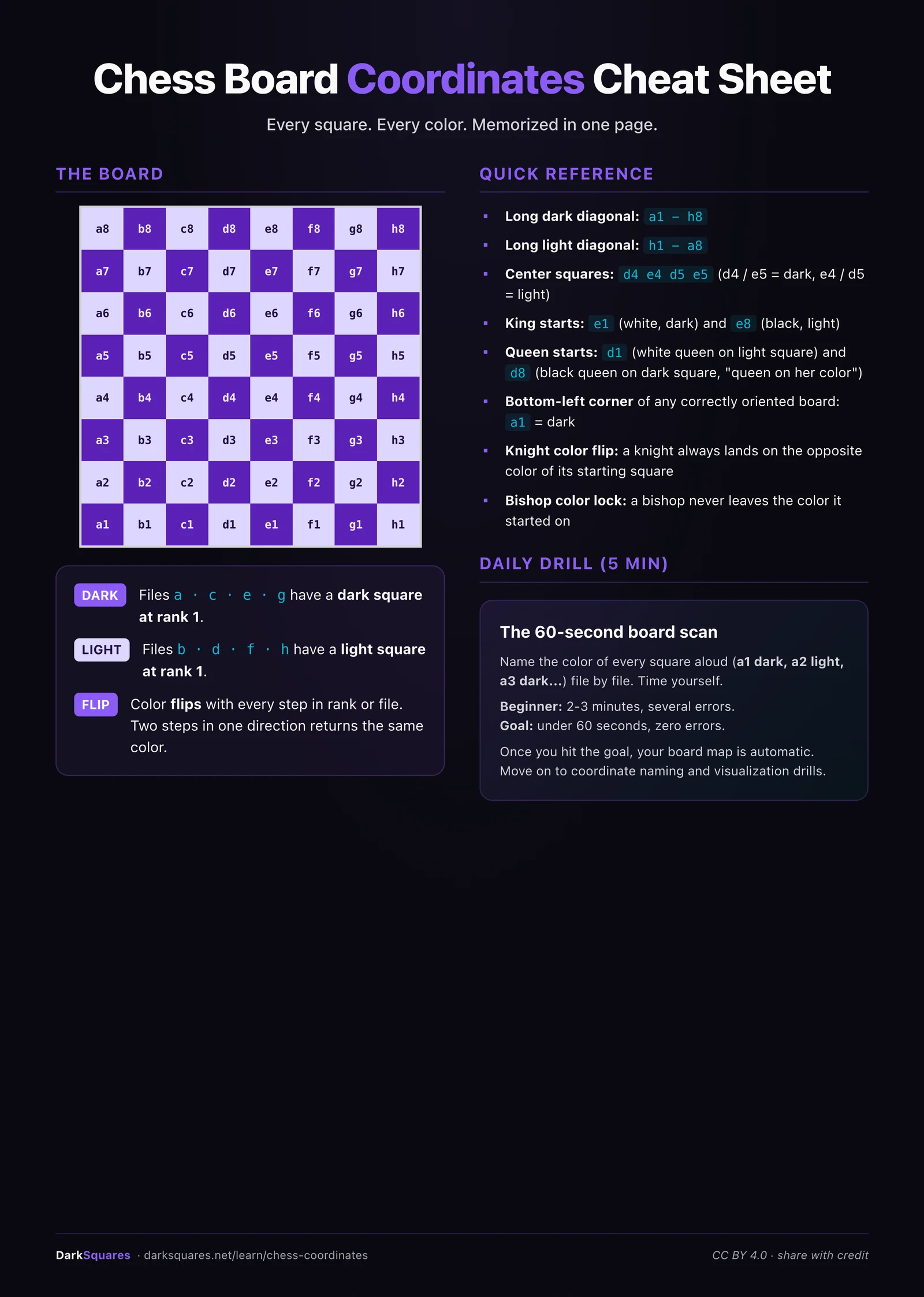
From Black's side the board flips: the h-file is on your left, the a-file on your right, and rank 8 is nearest you. The coordinates themselves never change, a1 stays a1 wherever you sit; only your orientation does. That flip is worth drilling on its own, which is why the coordinate trainer lets you run every session from White's or Black's side of the board.
The cheat sheet helps while the names are new, but you do not need a printed board with coordinates to memorize this: the drills below turn the a1-to-h8 map into instant recall, so you can name any square with the board blank or entirely in your head.
Why does board vision matter?
Chess board vision is what separates a player who calculates fluently from one who runs out of mental capacity at move three. Every move you make in calculation requires updating the mental image: the knight moves from f3 to e5, the e5 pawn captures, the bishop on g2 now eyes a8. If your board map is shaky, every update costs time and accuracy.
Strong board vision shows up in three concrete places:
- Tactics: spotting forks, pins, and discovered attacks faster because you see square relationships, not just pieces
- Endgames: holding a king-and-pawn race in your head accurately, including who reaches which square on which move
- Time management: shorter clock spend per move because the board is automatic and you can focus on the position
How is coordinate training different from chess visualization?
The two skills work in sequence. Coordinate training builds the static map of the board. Visualization training builds the dynamic skill of moving pieces on that map and projecting positions forward.
Skipping coordinates and jumping into visualization is the most common plateau cause for players starting blindfold practice. The drills feel impossibly hard because every visualization step also requires a coordinate lookup. Get the coordinate work mostly automatic first and the rest of the progression accelerates noticeably.
How do you learn chess coordinates fast?
Three principles, ordered by impact:
- Daily, short, focused. 5 to 10 minutes every day beats one 90-minute session per week. Working memory consolidates between sessions, not during marathons.
- Drill the basics before the variations. Square colors first, then square names, then diagonals, then quadrants. Skipping ahead trains nothing because the previous step is not yet automatic.
- Verify every rep. Practising drills without checking your answer trains inaccuracy. The DarkSquares coordinate trainer gives instant feedback on every square, which is why it works faster than self-quizzing.
A useful weekly benchmark: name the color of every square on the board out loud (a1 dark, a2 light, a3 dark, on through h8). Time it. Beginners take 2 to 3 minutes with several errors. Sub-60 seconds with zero errors is your green light to move on to visualization drills.
Free chess coordinate drills
The DarkSquares board-vision track is five progressive drills. Each is a self-contained exercise with its own leaderboard. Run them in order; do not start drill three before drill two feels boring.
| Drill | Skill trained | Difficulty |
|---|---|---|
| Square colors | Instant light/dark recall | Beginner |
| Coordinate finder | Name any square by sight | Beginner |
| Quadrant mastery | Zone mapping (a-d/1-4 etc.) | Intermediate |
| Diagonal trainer | Diagonal recognition for bishops and tactics | Intermediate |
| Knight maze | Complex paths through the board | Advanced |
The coordinate drill itself is the central one and most players spend the longest there. Square colors is the warmup; quadrants and diagonals widen the view; knight maze stress-tests path tracing.
Coordinate notation: the 60-second primer
Algebraic notation labels each square by its file letter (a to h, left to right from White's side) and its rank number (1 to 8, bottom to top from White's side). White's king starts on e1. Black's king starts on e8. The dark square in the bottom-left of any correctly oriented board is a1.
Two facts worth memorizing because they save lookup time:
- Files a, c, e, g have a dark square at rank 1 (a1, c1, e1, g1 are all dark)
- Files b, d, f, h have a light square at rank 1 (b1, d1, f1, h1 are all light)
From those two facts you can derive any square's color: flip the color every time you change rank or file by one. With practice, deriving gets replaced by direct recognition.
A move adds a piece letter in front of the square: Nf3 is a knight going to f3. Captures, checks, castling and the rest are in the guide to reading algebraic chess notation.
From coordinates to blindfold chess
Coordinate training is step one of the seven-level DarkSquares progression. Once square names and colors are automatic, the next steps are:
- Piece movement drills: visualize a knight or bishop tracing a path between two squares with no board in front of you
- Position memory: study a small position briefly, then reconstruct it from memory
- Multi-move calculation: project forcing lines two, then three, then five moves ahead without moving pieces
- Faded board games: play a real game with the pieces fading away over time
- Full blindfold: an empty board, moves announced aloud, the position lives only in your head
If you want the full path, start with blindfold chess training and the visualization training guide. Both build on the coordinate work you do here.
Frequently asked questions
What are the coordinates of a chess board?
A chess board uses an 8x8 grid of coordinates. The columns (files) are labeled a to h from left to right on White's side, and the rows (ranks) are numbered 1 to 8 from White's side to Black's. Every square is named by its file then its rank, from a1 in White's bottom-left corner to h8 in the top-right corner from White's view, giving all 64 squares a unique coordinate.
How long does it take to learn chess coordinates?
Timelines vary, but a useful benchmark is daily 5 to 10 minute drills for a few weeks until square color and coordinate recall feel automatic. Going from slow recall to instant recognition tends to take an additional month of consistent practice.
What is chess board vision?
Chess board vision is the ability to see the 8x8 grid as structured information rather than 64 separate squares. It includes naming any square instantly, recognizing diagonals and ranks, knowing which squares a piece controls from any starting square, and updating that picture as pieces move.
How is coordinate training different from visualization training?
Coordinate training builds the static map of the board: square names, colors, and relationships. Visualization training builds the ability to track pieces moving on that map, hold positions in memory, and project several moves ahead.
Is the Lichess coordinate trainer enough?
Lichess coordinates is excellent for raw square-naming speed. DarkSquares adds the rest of the board-vision skill set: square colors, quadrants, diagonals, knight paths, and a structured progression that maps to blindfold and visualization training afterwards.
Does coordinate training help blindfold chess?
Yes. Blindfold chess fails most often because the underlying board map is not automatic. If you still need to compute whether f6 is a light or dark square, your working memory is full before the first move is played. Coordinate training removes that overhead.
Is coordinate training the same as notation training?
They overlap but are not identical. Notation training is learning to read and write moves in algebraic form (Nf3, Bxe5, O-O). Coordinate training is making the underlying square names automatic so you can read, write, and visualize without thinking. The DarkSquares coordinate drill trains the square names directly: it shows a coordinate such as f6 and you tap that square on the board, against the clock.
Do chess coordinates change when you play as Black?
No. Square names are fixed: a1 is always White's bottom-left corner no matter who is looking at the board. What changes is your orientation: from Black's side the h-file is on your left and rank 8 is closest to you. Because most players train only from White's view, drilling from Black's side is the fastest fix for misreading the board in your games as Black. The DarkSquares coordinate trainer runs from either side.