
Dark Squares vs Lichess: Blindfold Training Compared
Antoine Tamano8 min read
Table of contents
Blindfold chess compresses calculation and concentration into minutes of daily practice. Two platforms often come up for this work: Dark Squares and Lichess. They take very different approaches. This guide compares Dark Squares vs Lichess for blindfold and visualization training, so you can pick the right tool for your level and goals. For players also weighing Chess.com, see our Dark Squares vs Chess.com comparison, and for the wider field read our top 5 blindfold chess apps review.
Disclosure: Dark Squares is our product. We've aimed for a fair comparison, but readers should weigh our perspective accordingly.
Dark Squares vs Lichess at a glance
| Feature | Dark Squares | Lichess |
|---|---|---|
| Price | Free + €39 Pro Lifetime (one-time) | Free (donation-based) |
| Dedicated blindfold training | Yes, 7 progressive levels | No (blindfold is a board toggle) |
| Visibility modes | 5 (Full, Faded, Shadow, Ghost, Blind) | 2 (Visible or Blindfold) |
| Progression path | Structured 7-level curriculum | Open practice only |
| Coordinate trainer | Yes (with pattern drills) | Yes (Coordinate Trainer module) |
| Gamification | XP, 10 tiers, 20+ achievements | Leaderboards, arena trophies |
| Platforms | Web, iOS, Android | Web, iOS, Android |
| Play vs AI blindfold | Yes, 8 difficulty levels | Yes (Stockfish, any difficulty) |
| Tournaments | No | Yes (arena, swiss) |
| Opening explorer, analysis | No | Yes |
Dark Squares: built for visualization
Dark Squares is built for blindfold and visualization training, not general chess study. The core of the app is a 7-level progressive curriculum that moves you from full board visibility to full blindfold play in measured steps. See the blindfold chess learning hub for how the method is structured.
Five visibility modes sit at the heart of the method: Full (standard board), Faded (pieces dimmed), Shadow (outlines only), Ghost (pieces flicker on move), and Blind (empty board). You work through them as your mental board stabilizes, rather than flipping a single switch from sighted to blindfold.
Training is organised into five categories: Board Vision (square color, coordinates), Piece Movement (knight paths, bishop diagonals), Memory (position recall), Tactics (forks, pins, mates visualised), and Blindfold Play (full games at 8 AI difficulty levels). Each category has drills that run in 5 to 15 minute blocks, so practice fits real schedules. The coordinate trainer is the usual starting point.
Gamification keeps sessions consistent. An XP system, 10 progression tiers, and 20+ achievements reward repetition. Leaderboards and daily challenges add pressure that mirrors tournament clocks. The app is available in 6 languages (EN, ES, FR, DE, PT, HI) on web, iOS, and Android, and you can play a blindfold game against AI without any setup.
Pricing is simple: the Free tier covers all seven levels and AI difficulties 1 to 5. Pro Lifetime unlocks everything for a single €39 payment, with no subscription. See pricing for details. For the research underpinning the approach, our chess training app benefits article covers why structured digital tools outperform ad hoc practice.
What Dark Squares deliberately does not include: opening explorer, endgame tablebase, puzzle rush, live multiplayer, or tournaments. The app stays focused on one outcome, a reliable mental board, and leaves general chess practice to platforms like Lichess.
Lichess: a full chess suite with a blindfold toggle
Lichess is a free, open-source, donation-supported chess site with one of the largest active player bases in chess. It serves millions of games every day and is available on web, iOS, and Android. Core features include rated and casual play from bullet to classical, arena and swiss tournaments, Puzzle Storm, Puzzle Racer, Racing Kings, studies, an opening explorer, and full Stockfish analysis on every game, all free.
For visualization specifically, Lichess has a native Blindfold mode: open any game, go to Settings then Board, and enable Blindfold. The board renders empty (or with coordinates only), and you input moves in algebraic notation. It works for games against Stockfish at any level, against humans in any time control, and inside studies. There is no dedicated curriculum around it, it is a board setting. If you are new to online blindfold play, our guide to playing blindfold chess online covers platforms, tips, and drills to frame this decision.
Lichess also ships a separate Coordinate Trainer that drills square names against a timer, which pairs well with blindfold practice. The community is another strength: free arena tournaments run every few minutes around the clock, team battles are common, and studies let coaches share annotated lines publicly.
Where Lichess is thin for this specific goal: no progressive levels, no visibility modes between Visible and Blindfold, no structured path from square recognition to full blindfold games, and no per-skill analytics that tell you whether you lost the game because you forgot a bishop or because you calculated poorly. Improvement comes from doing more games and more analysis, not from guided drills.
How they compare in practice
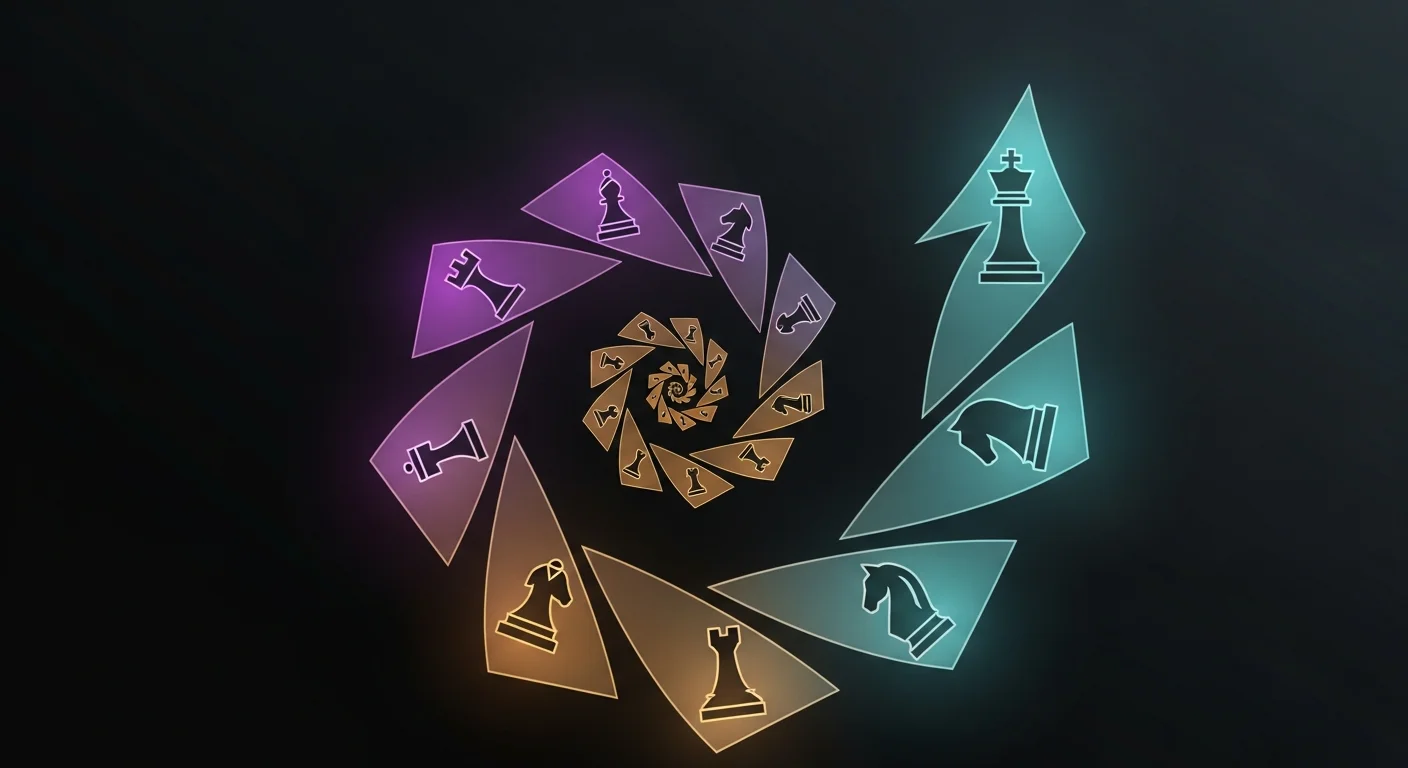
The platforms reflect two philosophies. Dark Squares builds visualization from first principles with targeted drills and graded visibility. Lichess drives improvement through immersion in real games and post-game analysis. Both work, for different starting points.
For beginners in blindfold work, Dark Squares is gentler. The Faded and Shadow modes let you practice calculation while your mental board is still forming, instead of facing a fully empty board on day one. Players above roughly 1600 who already hold the board in their head will adapt to Lichess blindfold games faster, because they can use their existing chess skills under a new constraint.
Progression differs sharply. Dark Squares enforces a skill tree: Board Vision, then Piece Movement, then Memory, then Tactics, then Blindfold Play, with XP and achievements marking each step. Lichess offers no guardrails. You can play hundreds of blindfold games without ever drilling square colors, which is fine if your weakness is calculation, and a problem if your weakness is tracking.
Cost is straightforward. Lichess is free forever, supported by donations. Dark Squares has a Free tier (all seven levels, AI 1 to 5) and a €39 Pro Lifetime unlock for the full curriculum on the pricing page. There is no monthly subscription on either side.
Depth of features outside blindfold is where Lichess wins cleanly. Opening explorer, tablebase, puzzles, studies, tournaments, team play, and analysis are all free. Dark Squares intentionally ships none of these, focusing instead on the dedicated visualization module.
Which to pick by level
Under 1400, start on Dark Squares for 4 to 6 weeks, then add Lichess games. From 1400 to 1800, drill weak sub-skills on Dark Squares while playing periodic blindfold games on Lichess. Above 1800, lean on Lichess for volume and return to Dark Squares modules when specific patterns (knight paths, long diagonals) start to slip.
Choosing for your goals
Pick for your current skill, goals, and available time. If you are rated 1200 and cannot yet name square colors instantly, drilling on Dark Squares will clear the bottleneck faster than more games on Lichess. If you are 1800 and lose blindfold games to time pressure rather than memory, Lichess volume is the right answer.
Match platform to learning style
Structured learners who like visible progress graphs and clear targets fit Dark Squares. Context-driven learners who improve best through immediate consequences and real games fit Lichess, where every mistake shows up on the board and in the engine analysis afterwards. For a view on how AI opponents and engines fit into this, see our guide to AI chess training games.
Time blocks matter
Dark Squares is excellent for 10 to 20 minute sessions with natural stopping points. Lichess blindfold games take 15 to 60 minutes depending on time control. If your schedule offers short daily windows, lean Dark Squares. If you have a few longer weekly blocks, stack Lichess games.
A hybrid plan works for most players
Start on Lichess with a free account and play five blindfold games against Stockfish at 1+0. If pieces disappear from memory, move to Dark Squares for 2 to 3 weeks on square colors, coordinates, and knight paths, then return to Lichess games. If pieces stay on the board but your calculation is slow, keep playing on Lichess and drill specific Dark Squares modules only for the patterns you keep missing.
Key takeaways
Dark Squares is focused: 7 progressive levels, 5 visibility modes, XP and achievements, web plus iOS plus Android, Free or €39 Pro Lifetime.
Lichess is a full chess suite with a free native Blindfold board toggle and a separate Coordinate Trainer, but no progressive curriculum.
Under 1400, build foundations on Dark Squares. 1400 to 1800, combine drills and games. Above 1800, Lichess volume plus targeted Dark Squares modules.
Short daily sessions favour Dark Squares. Longer weekly sessions favour Lichess.
They are complementary, not competitors, for serious visualization work.
Micro-action for today: play one blindfold game on Lichess against Stockfish at 3+2, and write down whether your losses came from memory slips or calculation mistakes. That tells you which platform to prioritise next.
Related reading
Frequently Asked Questions
Which is better for blindfold chess training: Dark Squares or Lichess?
Dark Squares for structured learning; Lichess for free volume. Dark Squares has a 7-level progressive curriculum with 5 visibility modes, coordinate drills, and analytics. Lichess offers a blindfold board toggle and a coordinate trainer, but no structured path. Under 1400, start on Dark Squares. Above 1600, combine both.
Does Lichess have a blindfold chess mode?
Yes. In any Lichess game, go to Settings → Board and enable Blindfold. The board renders empty and you input moves in algebraic notation. It works for games against Stockfish at any level and against human opponents. There is no dedicated curriculum around it — it's a board setting, not a training system.
Is Dark Squares worth paying for over free Lichess?
If your goal is systematic blindfold improvement, yes. Lichess's free blindfold toggle and coordinate trainer are genuinely useful, but they provide no progression path, no staged visibility levels, and no analytics. Dark Squares Pro (a one-time purchase) adds the hardest drill difficulties, expert blindfold tactics, the top AI levels, and the full famous games and endgame libraries. The free tier covers all seven levels with no payment required.
Can I use Dark Squares and Lichess together?
Yes, and most serious players do. Use Dark Squares for structured drills (coordinates, piece tracking, visibility levels) during short daily sessions. Use Lichess for full blindfold games, post-game engine analysis, and tournaments. The skills transfer directly: pattern gaps found in Lichess games become Dark Squares drill targets.
How does the Dark Squares coordinate trainer compare to Lichess's?
Both train square-name recall, but differently. Lichess flashes a square and times your click. Dark Squares adds pattern drills that build the spatial map underlying coordinate fluency, and connects coordinate training to the next levels (piece movement, position memory). For beginners, Dark Squares's progression is more structured; for players who already have solid coordinates, Lichess's timer adds useful speed pressure.
Last updated
Related Articles
Magnus Carlsen and Blindfold Chess: How the Champion Trains Without the Board
Magnus Carlsen and blindfold chess go beyond a stunt. In New York in 2015 he tracked three boards with clocks, and in Vienna he faced five opponents w…
Antoine · 8 min read
How to Choose a Blindfold Chess Trainer: Features That Actually Matter
Disclosure: Dark Squares is our product. We have aimed for a fair comparison, but readers should weigh our perspective accordingly. Blindfold training…
Antoine · 7 min read
10 Classic Drills Masters Use to Train Blindfold Visualization
Blindfold chess is not magic. Miguel Najdorf played a 45-board blindfold simul in São Paulo in 1947, and George Koltanowski set a 56-game consecutive…
Antoine · 7 min read