
You calculate a rook lift, a knight jump, and a pawn break. Three moves in, your mental board wobbles. The bishop on f4 might be on d4. You retrace, waste two minutes of clock, and settle for the safe move. That wobble is not a character flaw. It is untrained visualization, and the fix is chess visualization training: every player above beginner level has felt that wobble, and every one of them can drill it away.
Chess visualization is the skill that lets you see positions, track pieces, and evaluate variations without a physical board. It underpins tactics, calculation, and endgame technique. It also responds to targeted practice, the same way tactics respond to puzzles. This guide explains what chess visualization training actually is, why it works, and how to build it from square recognition to full blindfold play.
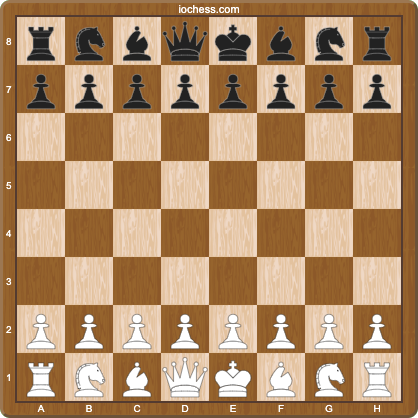
What chess visualization training actually is
Chess visualization training is the deliberate practice of building, updating, and evaluating mental board positions without physical reference. It is not photographic memory. Adriaan de Groot demonstrated this in his 1946 thesis Het denken van den schaker (translated as Thought and Choice in Chess in 1965), and William Chase and Herbert Simon confirmed it in their 1973 "Perception in Chess" study, showing that chess masters reconstruct real positions near-perfectly but do no better than novices on random piece arrangements. Their edge comes from pattern recognition, not raw recall.
The three abilities under the hood
Visualization breaks down into three trainable components. First, holding a position clearly enough to query it, for example, "is e4 light or dark, and what defends it?". Second, updating the image accurately as pieces move, which is where most calculation errors begin. Third, evaluating what you see, so you can compare two candidate lines on their merits rather than their length. If you want to isolate that second skill, our position reconstruction trainer drills exactly this: show a position, hide it, rebuild it.
According to the Dark Squares Chess Visualization Training Guide, these abilities separate strong calculators from players who rely on surface patterns.
Chunks, not coordinates
Chase and Simon's key finding was that masters store chess in chunks of meaningful structure. A kingside fianchetto, a knight outpost on d5 supported by pawns, an isolated queen's pawn. Where a beginner tracks 32 separate pieces, a master tracks 5 to 6 structural clusters and fills in the details from memory. Gobet and Simon (1996) later refined this into template theory, estimating that a master has built a library of 50,000 or more chess patterns through years of study and play. This is why visualization training feels easier as you progress. You are not getting better at memorization. You are building a pattern library that lets your working memory hold more chess with the same effort.
Why chess visualization training matters
Without it, tactical combinations collapse mid-calculation, opening preparation fades the moment positions deviate from memorized lines, and endgame technique becomes guesswork. If you are still unsure this skill applies to your level, the case for playing blindfold chess lays out the competitive and cognitive payoff in concrete terms.
Concrete impact on play
Players who train visualization tend to make fewer mistakes and avoid more risky moves in rapid and blitz formats. They also recover more time on the clock, because verifying the mental board takes less effort. At the 2015 Sohn Conference blindfold simul (covered by TIME and Chess.com), Magnus Carlsen described the difficulty as the clock rather than the playing itself: "manageable for a good chess player to play blindfold, but really the time control does not allow me any time to think." He has noted elsewhere that strong opponents are actually easier to play blindfold against, because their moves slot into recognized patterns; irregular moves from weaker opponents are what break the mental board.
Cognitive benefits confirmed by neuroscience
Bilalić and colleagues (2011) used fMRI to show that expert chess players recruit the bilateral fusiform gyrus more strongly than novices when processing chess positions, consistent with specialised perceptual expertise. A 2024 graph theory study in Frontiers in Psychology (Gonzalez-Burgos et al., PMC11442243) showed that adult chess players display a distinct cognitive connectome across attention, working memory, and perceptual modules compared with non-players. Working memory for chessboards is domain-specific. It does not transfer to random visual memory, but it does generalize partially to spatial tasks like mental rotation.
The competitive ceiling
Grandmaster Timur Gareyev set the Guinness-verified world record on 3 and 4 December 2016, playing 48 simultaneous blindfold games at the University of Nevada Las Vegas over 19 hours and 9 minutes, scoring 35 wins, 7 draws, and 6 losses while cycling on a stationary bike (Guinness World Records). Gareyev's score of 80.2 percent against serious opposition shows what sustained visualization can reach. You do not need to approach 48 boards. A reliable 10 to 15 moves ahead in your own games is life-changing on the scoresheet. For a more grounded look at the mental routines top players actually use, see five visualization techniques from top chess players.
The science of mental imagery and aphantasia
A common worry among new students of blindfold chess: "what if I cannot see pictures in my head?" Aphantasia, the inability to voluntarily form mental imagery, was formally characterized by Zeman and colleagues in 2015 and is understood to affect a portion of the population. The good news: it does not prevent chess visualization.
The reason sits in how expert visualization actually works. Alfred Binet studied blindfold chess players in the 1890s and concluded, in his 1894 book Psychologie des grands calculateurs et joueurs d'échecs, that even strong blindfold players do not hold a literal photograph of the board. They hold an abstract representation, a network of relationships between pieces, squares, and threats, often described in terms closer to language than vision. Chase and Simon's chunking model, and Gobet and Simon's template theory, are direct descendants of that insight.
This matters practically. Players with aphantasia can and do play strong chess. What they need is to lean harder on verbal encoding (naming squares and pieces aloud), structural encoding (thinking in pawn chains, files, and diagonals), and pattern retrieval (recognising "this is a Lucena-style setup") rather than trying to picture the board photographically. The 7-level Dark Squares progression works for both visualisers and non-visualisers because it trains recognition and relationships, not pictures. If you think a specific bottleneck (aphantasia or otherwise) is blocking you, our walkthrough of common visualization problems and how to overcome them is the next stop.
If you have never been tested, do not self-diagnose. Try the drills first. Most players who think they "cannot visualise" simply have not practised enough square recognition to make the board automatic.
How to measure your chess visualization training progress
You cannot improve what you do not measure. Three simple benchmarks let you track progress without any special equipment.
1. Square color recognition speed. Name the color of all 64 squares aloud (a1 dark, a2 light, a3 dark, and so on, file by file). Target: under 60 seconds with zero mistakes. Beginners often take 2 to 3 minutes and miss several. Sub-60 is a solid foundation for blindfold work.
2. Mental knight tour. Starting on a1, move a knight to h8 using only legal knight moves, speaking each square aloud, with no board in front of you. Target: under 2 minutes without backtracking through an illegal move. This tests piece path tracing, the hardest visualization sub-skill after square colors.
3. Blindfold game length. Play a blindfold game against a weak engine (AI 1 or 2) with the empty-board mode. Count how many moves you play before you make an illegal move or lose track. A useful ladder: 5 moves (beginner), 15 moves (intermediate), 30 moves (advanced), full game (expert).
Log your numbers weekly in a notebook or spreadsheet. Visualization responds to practice the same way physical strength responds to training, and the feedback loop only works if you can see the curve bending.
How chess visualization training works
Effective training does not need hours. Short, structured daily sessions of 10 to 20 minutes produce measurable gains in weeks. The principle is progressive overload applied to working memory, exactly the same as physical strength training.
The progression
Start with square recognition, so you can name any square's color in under 2 seconds. Next, piece path tracing, where you follow a knight or bishop from one square to another through intermediate positions held only in your head. Then position memory, studying a setup briefly and reconstructing it without looking. Finally, multi-move calculation, where you project forcing lines without moving pieces. Our guided visualization trainer sequences these stages automatically so you never skip one by accident. These same building blocks power dedicated board vision drills that make every square automatic.
Each stage locks in before the next is added. Players who skip ahead usually stall at full blindfold games because their underlying board map is not automatic.
Warmup before calculation
Begin each session with a short visualization warmup before moving into puzzles or analysis. This primes the visual cortex and makes subsequent calculation feel fluent. Players who skip warmups often report that their first puzzles feel heavier than puzzles 20 minutes into a session.
Blindfold play as the apex
Blindfold chess, playing an entire game without seeing the board, is the most demanding form of visualization training. Our 7-step beginner journey walks through the progression from basic square recognition to full blindfold games. For a dedicated deep dive into playing entirely in your head, our guide to mental chess training covers the full path from first drill to a complete blindfold game. Starting with guided, incremental steps makes the process far less intimidating than attempting a full blindfold game on day one. If you would rather practise on the go, compare the best blindfold chess apps before you settle on a tool.
Three training methods that work
Method 1: The audio method
Listen to move sequences called aloud or recorded, visualizing board changes without looking at any position. Players who run audio drills at the start of each session consistently report sharper tactical recognition deeper into positions during actual games. The brain, stretched by the audio drill, finds in-game calculation comparatively easy.
Method 2: Historical game reconstruction
Use classical games as visualization material. Try Morphy's Opera Game (Paris, 1858), a 17-move masterpiece against Duke Karl and Count Isouard. Visualize the opening three moves before seeing them played out. The goal is tracking, not deep analysis. Can you see where each piece will be after three moves without losing any of them mentally? This drill is particularly effective for players rated 1300 to 1600.
Method 3: Verbal narration drills
Set up a position, narrate 5 to 10 moves aloud while visualizing them, and describe the final position without moving any pieces or looking back. This builds the tracking skills needed for midgame dynamics and endgame planning several moves ahead. It is especially useful for players working on calculation depth.
Common pitfalls and how to avoid them
Most visualization plateaus come from a small set of repeatable mistakes. Watching for them saves weeks of stuck practice.
Skipping the fundamentals. The single most common error is jumping straight to blindfold games before square colors and coordinates are automatic. If you still have to compute "is f6 light or dark", your working memory is already full before the first move is played. Drill the basics until they are boring, then move on.
Trying blindfold games too early. A full blindfold game asks you to hold 32 pieces, update them every move, and calculate lines on top of that. Start with 5-move positions, then 10-move positions, then partial-visibility games (Faded, Shadow, Ghost) before a fully empty board. The Dark Squares visibility progression exists because this gradient matters.
Inconsistent practice. Ten minutes a day for six weeks beats two hours once a week. Pattern consolidation happens during rest between sessions, so spacing matters more than total volume at this stage. The spacing effect, documented from Ebbinghaus (1885) through Cepeda et al. (2006), shows distributed practice consistently outperforms massed practice for skill acquisition.
Expecting linear progression. Visualization improves in plateaus and jumps, not smooth curves. You will spend two weeks feeling stuck, then suddenly find you can hold a 20-move line that felt impossible a month ago. Track your weekly benchmarks (see above) so the plateau is obvious as a plateau, not as failure.
Practising without feedback. Doing blindfold drills without checking whether your final position is correct trains inaccuracy. Always verify. The Dark Squares app handles this automatically, but if you drill with a friend or a notebook, build the verification step into every rep.
Common misconceptions
"It is only for advanced players"
Many beginners assume visualization training is something to tackle after mastering openings and endgames. The opposite is true. Building visualization habits early accelerates every other area of improvement. Even basic square color drills, taking only minutes per day, create a foundation that makes all future learning more efficient.
"You either have it or you don't"
Visualization is widely misunderstood as fixed talent. Research and training data consistently show otherwise. The capacity for mental imagery improves with targeted exercise, as Bilalić et al. (2011) and the 2024 PMC study confirmed by comparing brain activation patterns between experts and novices. Even players with aphantasia can develop functional visualization through the compensatory verbal and structural techniques described above.
Start chess visualization training today
Chess visualization training builds the mental board that tactical, positional, and endgame play all rely on. The research is clear. Chase and Simon's chunking model, refined by Gobet and Simon's template theory and confirmed by Bilalić's fMRI work and 2024 cognitive-network analysis, shows that visualization skill lives in domain-specific pattern libraries, not general memory capacity. Training those libraries takes 10 to 20 minutes a day of progressive drills, from square recognition through blindfold play.
Start with the audio method, historical game reconstruction, or verbal narration. Any of the three works if you stay consistent. Add complexity only when accuracy holds. If you want a structured path, the Dark Squares progressive training program takes you from first drill to full blindfold games, with performance tracking that surfaces your weak spots automatically. When you are ready, start a live blindfold game at whichever visibility level matches your current benchmarks and let the app track how many accurate moves you hold before the board fades.
Related reading
Sources
Chase, W. G., and Simon, H. A. (1973). Perception in Chess. Cognitive Psychology, 4(1), 55-81.
de Groot, A. D. (1946). Het denken van den schaker. Doctoral thesis, University of Amsterdam. English translation: Thought and Choice in Chess (Mouton, 1965). Foundational study of how chess masters perceive and choose moves.
Binet, A. (1894). Psychologie des grands calculateurs et joueurs d'échecs. Paris: Hachette. Foundational study of blindfold chess psychology, establishing that expert blindfold play relies on abstract position understanding rather than photographic memory.
Gobet, F., and Simon, H. A. (1996). Templates in Chess Memory: A Mechanism for Recalling Several Boards. Cognitive Psychology, 31(1), 1-40. Template theory and the 50,000+ pattern estimate for master-level chess.
Bilalić, M., Langner, R., Ulrich, R., and Grodd, W. (2011). Many Faces of Expertise: Fusiform Face Area in Chess Experts and Novices. Journal of Neuroscience, 31(28), 10206-10214. fMRI evidence of perceptual expertise in chess.
Zeman, A., Dewar, M., and Della Sala, S. (2015). Lives without imagery: Congenital aphantasia. Cortex, 73, 378-380. Original characterisation of aphantasia.
Cepeda, N. J., Pashler, H., Vul, E., Wixted, J. T., and Rohrer, D. (2006). Distributed practice in verbal recall tasks: A review and quantitative synthesis. Psychological Bulletin, 132(3), 354-380. Meta-analytic evidence for the spacing effect.
Most simultaneous blindfolded chess games, Guinness World Records.
Magnus Carlsen at the 2015 Sohn Conference blindfold simul, TIME.
Magnus Carlsen on blindfold play and time pressure, Chess.com coverage of the 2015 Sohn Conference.
Frequently Asked Questions
Last updated: Jun 19, 2026


Comments