
Pawn Endgame Principles for Blindfold Play: Lucena, Philidor, Opposition
Antoine9 min read
Table of contents
Blindfold endgame skill converts half-points in long games. In opposition, kings face each other with one square between them, and the side not to move controls the entry square. Lucena wins rook-and-pawn endings, Philidor draws them. With 15 to 20 minutes a day for 4 to 6 weeks, you can run these lines without a board, saving energy during real games. You will learn pawn endgame principles for blindfold play, Lucena, Philidor, and opposition, through concrete setups, key-square cues, and short drills you can repeat anywhere.
Prerequisites
Before attempting blindfold pawn endgame training, ensure you have:
- Algebraic notation: Name any square, such as e4 or d5, without a board
- Endgame basics: Know key squares, how pawns promote, and active king paths
- Square colors: Identify the color of any target square instantly
- Daily focus time: Schedule 15 to 20 quiet minutes for practice
- Blindfold foundations: Review the 7-step beginner blindfold journey before endgames
Optional but helpful: Use a chess app or site that lets you set up positions for post-drill verification.
Step 1: Build Foundation with Static Position Visualization
Start with static features, not moves. Name square colors from the initial setup, then test relations, such as whether the kings share a file or diagonal, and the distance between pieces.
- Set up verbally: White king e4, white pawn e5, black king e7
- Close your eyes and place the three pieces mentally
- Ask static questions: square colors, same file or rank, distance in squares
- Spend 3 to 5 minutes per position before changing
- Verify on a board or app to confirm accuracy
This builds logical memory, not snapshots. Begin with two kings or K+R vs K, then add one piece at a time as recall stays accurate. For a deeper foundation on static visualization, see the complete guide to mental board skills.
Use targeted drills like the Dark Squares coordinate trainer to strengthen your mental board.
Step 2: Master Opposition Principles Blindfolded
Opposition forces the enemy king back so you can reach key squares. Direct opposition occurs with kings on the same file or rank with one square between them, and the side not to move holds it.
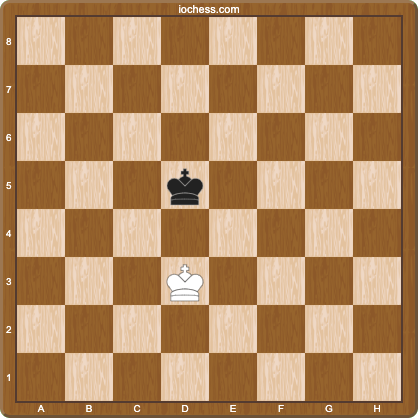
- Direct opposition: Example, WK e4 vs BK e6. If Black to move, White holds the opposition
- Distant opposition: Kings on the same file or rank with an odd number of empty squares between them (three, five, or seven), such as WK e2 vs BK e6 with three squares between
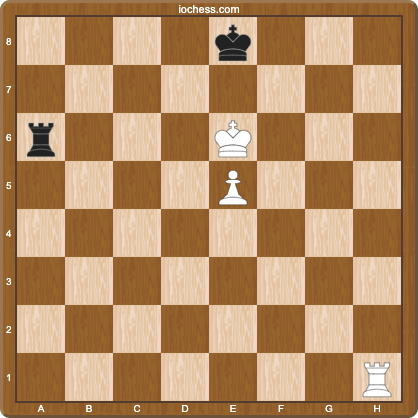
- Practice, WK e6, WP e5, BK e8. Visualize which side to move wins
- With White to move, your king is already on the sixth rank in front of the pawn, so you win by advancing and outflanking: 1.Kd6 (or 1.Kf6) wins, meeting 1...Kd8 with 2.e6 and 1...Ke8 with 2.e6 and the pawn escorts home. Do not retreat to the fifth rank: 1.Kd5 and 1.Kf5 only draw because Black holds with 1...Ke7. Guiding principle: once your king reaches the sixth rank in front of the pawn, keep advancing to win; stepping back lets the defender hold
- Project 5 to 7 moves until the pawn queens or is stopped
Use opposition to reach key squares in front of your pawn, such as e6 for an e-pawn. Do not chase opposition without a path that penetrates and escorts the pawn.
Rule of thumb: Keep your king in front of its pawn, not behind it. Use opposition to push the enemy king back and seize entry squares. For more endgame visualization practice, see blindfold endgame training.
Step 3: Visualize the Lucena Position (Winning Technique)
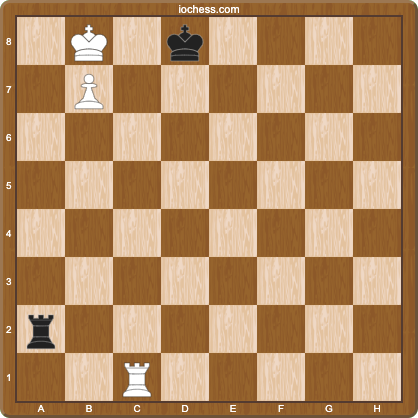
The Lucena position is a fundamental rook-and-pawn endgame, and "building a bridge" uses your rook to shield the king from checks while promoting. It is the winning method in rook-and-pawn versus rook when your pawn is on the seventh rank and your king is in front of it. The defender's rook checks from the side while the defender's king is cut off by at least one file.
- Cut the enemy king off by one file with your rook before advancing
- Get your king in front of the pawn on the seventh rank
- Build a bridge on the fourth rank with your rook, for example Rc4 or Rd4
- Walk the king out under the rook's shelter, then promote the pawn
- Drill the plan until you can recite and execute 8 to 10 moves mentally
Key cues: the defender's rook checks from the side, your rook blocks checks from the fourth rank, and your king steps toward the back rank under cover. If your rook cannot reach the fourth rank, shift files until it can.
Step 4: Practice the Philidor Position (Drawing Technique)
Philidor is the drawing method when the defender's king is in front of the pawn and the defender's rook can hold the third rank. In the Philidor position the defender keeps the rook on the third rank to stop the enemy king advancing, then drops it to the back rank to check from behind once the pawn pushes to the sixth.
- Place the defending rook on the third rank, a3 to h3, to bar the king
- Keep the defending king in front of the pawn's file
- If the pawn reaches the sixth rank, shift the rook behind and give checks
- Do not allow the attacking king to shelter on the sixth, check laterally first
- Train both sides, hold as defender and probe as attacker
Philidor holds with the pawn on the fifth or sixth rank when the king blocks the file and the rook controls the third rank. If the pawn reaches the seventh with the attacking king in front and the defender's king is cut off, aim for Lucena instead.
Step 5: Train With Progressive Endgame Positions
Combine skills with positions that grow in complexity. Spend up to 15 minutes per position. If you stall, peek at the diagram, reset, and solve blindfolded again. A good structured approach echoes the structured blindfold training regimen.
- Week 1 to 2: King and pawn vs king, win with opposition
- Week 3 to 4: Two-pawn races, count tempi for both sides
- Week 5 to 6: Basic Lucena and Philidor setups
- Week 7+: Mixed endings, choose winning or drawing plans
For each position:
- State the setup aloud using algebraic notation
- Visualize the full board for 2 to 3 minutes
- Calculate 10 to 15 minutes, keeping a main line and key sidelines
- Write your line in notation, then verify on a board or app
- Review errors, then redo the position blindfolded
Use the Dark Squares progressive training modules to scale difficulty as your accuracy improves.
Step 6: Apply the Square Rule for Pawn Races
Use the square rule to see if a king catches a passed pawn without a board. This decides instantly whether a pawn can queen unaided or must be supported.
- Identify the pawn, for example pawn on a4
- Count squares to promotion, a4 to a8 is 4 moves
- Visualize a 4x4 square: a4, a8, e8, e4, a4
- Check if the enemy king is inside or can enter on its move
- If inside, the king catches the pawn. If not, the pawn queens
Remember tempo: if it is the defender's move, the king may step into the square, if the pawn moves first, the square shrinks and the king may be too late. Capablanca famously advised, "you must study the endgame first," and this rule is a cornerstone of that study.
Step 7: Develop Recognition Through Repetition
Drill for instant cues, such as direct vs distant opposition, fourth-rank bridge, and third-rank barrier. Quick recognition turns long calculations into short, reliable plans.
- Morning, 5 minutes: Visualize 2 to 3 opposition positions
- Midday, 10 minutes: Solve one Lucena or Philidor drill blindfolded
- Evening, 5 minutes: Run 5 to 10 square-rule tests with different pawns
Track your progress:
- Depth, how many accurate moves you can hold
- Setup time to visualize the full position
- Success rate versus best play
- Patterns that cause errors, such as lateral checks
For a broader set of drills that records accuracy over time, review the 9 essential blindfold exercises for every level.
Common Mistakes and Troubleshooting
Even experienced players miscue specific blindfold endgames. Fix the common issues below with targeted drills and move counting.
Mistake 1: Losing Track of Square Colors and Piece Positions
Confusion with colors or diagonals breaks the mental image. If you blur pieces mid-line, the position is too complex for your current stability.
Solution: Drill square colors and static questions first. Use daily square-color exercises, then add moves only after you answer static checks instantly. The square colors drill is foundational.
Mistake 2: Misjudging Pawn Races and King Movement
Players often guess tempi instead of counting both sides. Blindfolded, one missed tempo flips a win to a draw or loss.
Solution: Ask early, "can the pawn run?" Count moves for both sides explicitly, then recheck after each push or king step.
Mistake 3: Misplacing the Rook in Lucena or Philidor
Attackers rush the king without building a fourth-rank bridge, or defenders abandon the third rank too soon. Both errors hand counterplay.
Solution: Lucena checklist, king in front, enemy king cut off, rook to fourth rank, then walk out. Philidor checklist, king blocks pawn file, rook on third rank, then checks from behind after the pawn reaches the sixth.
Conclusion
- Opposition wins entry squares, the side not to move holds direct opposition
- Keep the king in front of its pawn and aim for key squares to escort it
- Lucena, cut off the king, build a fourth-rank bridge, then promote
- Philidor, hold the third rank, keep the king in front, then check from behind
- Square rule, build the promotion square and count tempo to decide races
Micro-action: Today, speak one Lucena setup aloud, solve it blindfolded in under 10 minutes, then verify on a board. Repeat once as the defender to test recall under pressure.
Next, follow the progressive visualization exercises and keep sessions short and accurate, then add complexity week by week. Review the endgame mastery guide to layer more technical endings onto your mental board.
Frequently Asked Questions
How can I effectively practice blindfold chess endgames without a board?
To practice effectively, dedicate 15-20 minutes each day to visualize endgame positions using algebraic notation. Start by naming the positions aloud, then close your eyes to recreate them mentally. Afterward, verify your accuracy on a board or app. This method builds strong visualization skills necessary for blindfold play.
What are the key principles I should remember for the Lucena position?
In the Lucena position, your rook should cut off the enemy king by one file, and your king must be positioned in front of the pawn on the seventh rank. You should create a 'bridge' on the fourth rank with your rook to protect your advancing pawn. Practice mentally walking through the sequence of moves to ensure you can execute it during a game.
What effective strategy should I use for the Philidor position?
In the Philidor position, keep your defending rook on the third rank to block the enemy king’s approach, while ensuring your king remains in front of the pawn's file. If the pawn reaches the sixth rank, move the rook behind it to deliver checks. It's crucial to prevent the attacking king from gaining shelter on the sixth rank.
How can I memorize the square rule for pawn races?
To memorize the square rule, visualize a square that extends from the pawn's position to the promotion square. If the enemy king can enter this square, it will catch the pawn before promotion. Use practice examples to reinforce this rule, checking if the king can step into the square based on whose turn it is to move.
What common mistakes should I avoid when practicing blindfold endgames?
Common mistakes include losing track of square colors and piece positions, misjudging pawn races, and misplacing the rook in Lucena or Philidor positions. Focus on color drills and static questions to strengthen your mental image. Ensure you always count both sides’ moves accurately to avoid tempo errors, which can drastically affect your chances of winning or drawing.
How do I measure progress when training for blindfold endgames?
Track your progress by assessing how many accurate moves you can recall without visual aids and the time it takes to visualize the full position. Keep a record of your success rate against optimal play and note patterns leading to errors. Regularly review your performance to identify weaknesses and areas for improvement.
What specific drills can I use to improve my opposition skills?
Practice drills focusing on direct and distant opposition scenarios. Set up positions where you visualize which side to move wins based on the opposition principles. Aim to mentally project several moves ahead and work on different variations to solidify your understanding and application during actual games.
How long will it take to improve my blindfold endgame skills?
With consistent practice of 15-20 minutes daily for 4-6 weeks, most players can significantly enhance their blindfold endgame skills. Results may vary depending on your current skill level and familiarity with fundamental endgame principles. Regularly reviewing and drilling various positions will help solidify your understanding and recall.
Last updated
Related Articles
Magnus Carlsen and Blindfold Chess: How the Champion Trains Without the Board
Magnus Carlsen and blindfold chess go beyond a stunt. In New York in 2015 he tracked three boards with clocks, and in Vienna he faced five opponents w…
Antoine · 8 min read

How to Choose a Blindfold Chess Trainer: Features That Actually Matter
Disclosure: Dark Squares is our product. We have aimed for a fair comparison, but readers should weigh our perspective accordingly. Blindfold training…
Antoine · 7 min read

10 Classic Drills Masters Use to Train Blindfold Visualization
Blindfold chess is not magic. Miguel Najdorf played a 45-board blindfold simul in São Paulo in 1947, and George Koltanowski set a 56-game consecutive…
Antoine · 7 min read