
Many players report sharper blindfold calculation within 2 to 3 weeks of consistent daily training, though individual progress varies. Blindfold chess puzzles with progressive difficulty exercises build board vision, memory, and speed through short, structured drills that scale from squares to full games. If you lose track after 8 to 12 moves or forget piece locations mid-line, this plan fixes those gaps. Follow the step-by-step system below, practice 10 to 30 minutes a day, and expect measurable gains over 20 to 30 days, with mastery taking longer.
For the underlying theory and the broader pillar that this drill plan sits inside, see our blindfold chess learning hub and the complete chess visualization training guide.
Prerequisites
Set yourself up for consistent training with a quiet space and short, focused sessions. Track accuracy so you can raise difficulty only when ready.
- Basic chess knowledge: Know piece moves, rules, and algebraic notation a1 to h8
- Quiet practice environment: Use 20 to 30 minute blocks without interruptions
- Training tools: Use Dark Squares training exercises, puzzle books, or mobile apps
- Physical chess set (optional): Verify early attempts on a board, then phase it out
- Notebook or tracker: Log errors, accuracy, and recurring blind spots each session
If you are new to blindfold concepts, read the 7-step blindfold chess beginner journey for piece movement patterns and notation examples before starting Step 1.
Step 1: Master Board Familiarity and Square Colors
Learn the 64 squares cold by naming colors for 10 to 15 random squares per session from White's view, then Black's. This foundation supports every later drill and reduces errors in visualization.
Pick any square, for example g5, f4, a8, h7, or b4, and decide light or dark using a mental board, not formulas. This forces genuine visualization of files, ranks, and corners.
- Close your eyes and picture an empty board from White's side
- Pick a random square and name its color aloud
- Verify with a board or app immediately
- Repeat for 10 to 15 squares per session
- Track accuracy, aim for 90% or better before advancing
Use structured square color exercises that scale with your accuracy. Increase difficulty by switching to Black's perspective or naming all light squares on a given file or rank. For a deeper walkthrough, see the essential square colors drill.
Step 2: Practice Basic Piece Tours
Progress to piece routes without a board. Start with bishops, then rooks, then queens, and last knights, which require the most precise mental updates.
Example: visualize a bishop from g1 to f8 via g1, c5, f8. The color constraint makes mistakes obvious and builds diagonal mapping.
- Bishop paths: Two-move routes first, then longer diagonals, always naming intermediate squares
- Rook paths: Trace files and ranks square by square, including turns
- Knight paths: Find the shortest route between two squares, tracking each L-step
- Queen paths: Combine straight and diagonal segments into multi-step journeys
Verify routes on a board after each attempt. If wrong, repeat the exact journey until you complete it flawlessly three times. The guide to enhancing visualization skills covers the mindset side of these drills.
Step 3: Start with Minimal-Piece Positions
Shift from single-piece routes to small positions. Use 3 to 5 total pieces, such as basic king-and-pawn endgames, to keep the mental load manageable.

- Study a 3 to 5 piece position for 30 seconds
- Look away and reconstruct the board mentally
- Name each piece's square and whose move it is
- Check the diagram or board to verify
- If correct, hold the picture for 1 to 2 minutes
- If wrong, note missing or misplaced pieces and repeat
Build chunking to reduce load. For example, instead of "Ke4, Pd5 vs Ke6," think "opposition with an advanced d-pawn," which groups the idea into one unit. This echoes Chase and Simon's 1973 finding that masters recall more and larger chunks than class players.
Identify what fades first in your head. Many lose rooks or queens on the edge, or blur clusters of pawns. Once spotted, drill those pieces and board zones in later sessions.
Step 4: Solve Simple Tactical Puzzles Blindfolded
Advance to blindfold tactics. Start with one- and two-move puzzles, then raise difficulty only when accuracy is stable.
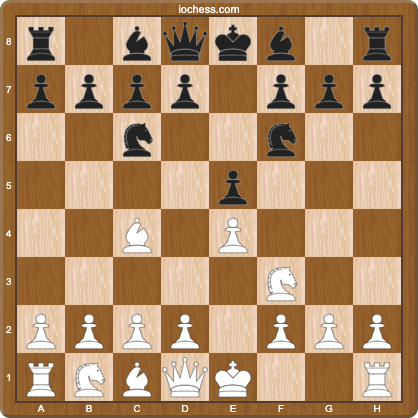
- Read or memorize the full position and side to move
- Look away and rebuild the board mentally
- Confirm each piece's square and key attackers and defenders
- Search forcing moves first, checks, captures, threats
- Calculate lines and replies fully in your head
- Verify your solution only after you are confident
Begin with puzzles rated 200 to 400 points below your normal tactical rating to build confidence. Use progressive puzzle training that adapts difficulty based on your success rate.
Step 5: Complete Knight Movement Challenges
Combine visualization with constraints. Example: a knight on h1 must visit every square a queen on d4 does not attack, without ever entering a queen-controlled square.

- Map all queen-controlled squares from d4, d-file, 4th rank, both diagonals
- Place your knight mentally on h1 and list legal safe moves
- Choose one move, update attacked and safe squares
- Continue until you cover all safe squares or get stuck
- Verify the path on a real board afterward
Change the queen's square to e5, c3, or f6 to vary patterns and prevent memorization. For related drills, see the 9 essential blindfold exercises for every level.
Step 6: Memorize and Replay Opening Theory
Rehearse your openings blindfolded, including how to meet common sidelines. This blends memory with calculation and punishing inaccuracies.
Example, Italian Game:
- From the initial position, visualize 1.e4 e5 2.Nf3 Nc6 3.Bc4 Bc5 4.c3 Nf6 5.d4
- After each move, pause and check the mental position
- Now try a deviation, 3...Nf6 instead of 3...Bc5. Choose your reply
- Calculate several moves deep, then verify on a board or engine
Start with 5 to 8 move lines and extend to 12 to 15 as stability improves. For background on how opening memorization combines with visualization, see chess memory techniques.
Step 7: Solve Complex Endgame Positions Blindfolded
Use technical endings to refine precision. After studying standard wins like queen vs rook or bishop and knight mate, play them out blindfolded against yourself to reinforce patterns and key techniques.
- Memorize the position from a book or database
- Spend up to 20 minutes solving it blindfolded
- Calculate the main line plus critical side lines
- Play both sides seriously, maximizing resistance when defending
- Check with an engine or tablebase for accuracy
- Label mistakes, visualization (wrong squares) or calculation (missed tactics)
Pick deeper studies to stress calculation, or choose piece-heavy middlegames to tax visualization. The blindfold endgame training guide covers Lucena, Philidor, and more.
Step 8: Replay Famous Games Mentally
Rebuild entire games in your head to combine memory, calculation, and evaluation. Start with short tactical battles of 15 to 25 moves before tackling strategic marathons.
- Select a classic, for example Morphy's Opera Game or Kasparov vs Topalov 1999
- Study it once with notes, then close the source
- Replay from move one mentally, position by position
- Speak moves in algebraic notation to reinforce sequence
- If you lose the thread, rewind to the last certain position
- Compare your recall to the game score afterward
Track a personal best, many start at 8 to 12 accurate moves, plateau around 15 to 18, then reach 25+ with steady practice.
Add quick mental annotations at key moments, for example "White's attack wins after opening f-file," or "Black's minor pieces dominate light squares." This strengthens understanding, not just recall.
Step 9: Analyze Your Own Games Without the Board
Blindfold self-analysis exposes real weaknesses and improves decision-making under strain. You test memory of your plans and calculate alternatives without aids.
- After a game, save the moves but avoid engine analysis
- Wait at least a few hours, ideally until the next day
- Replay the game mentally from memory, move by move
- Flag critical decisions and evaluate if they were justified
- Calculate candidate moves and expected consequences
- Write conclusions, then compare with engine evaluation
This reveals blind spots fast. Pieces you assumed were active may be misplaced, and missed tactics become obvious when you reconstruct positions mentally and check later.
Common Mistakes to Avoid
Most plateaus come from three issues, overestimating memory, skipping core visualization drills, and training without a plan or metrics.
Overestimating Memory Abilities
Photographic recall is not enough. Blindfold skill depends on piece relationships, for example knight forks or pawn chains, and often collapses around move 10 if you rely on rote memory. Chase and Simon's 1973 research showed masters have no advantage on random piece arrangements, only on real game positions, because they rely on pattern chunks, not photography.
Solution: Use coordinate anchoring. Name attacked squares mentally and verify instantly. Focus on interactions and patterns instead of isolated square names.
Skipping Fundamental Visualization Drills
Without static-position practice, sequential memory fails near move 12. Diagonals and knight jumps cause the most early errors, especially if you jump straight into complex puzzles.
Solution: Build static-to-dynamic drills. Name a piece's attacked squares, then move a knight five steps mentally. Working your way up through the complete visualization training guide gives a clear scaffold.
Practicing Without a Structured Plan
Random drills repeat easy tasks and bury weaknesses. Without goals or review, retention fades and motivation fades with sporadic sessions.
Solution: Set one measurable target per 20-day cycle, for example 90% accuracy reconstructing a 10-move sequence. Log date, drill type, errors, and notes. Re-test openings after six weeks and train daily in short blocks. See the structured blindfold training regimen for a day-by-day layout.
Also avoid deep blindfold calculation before static recall is stable, moving pieces during every line, and once-a-week marathons instead of daily short sessions.
Recommended Tools and Resources
Use tools that scale difficulty, track results, and offer targeted drills. These options cover gameplay, tactics, and visualization practice.
Online Training Platforms
Dark Squares: Built for blindfold progression with graduated exercises, blindfold play at 7 levels, progress tracking, and achievements. Difficulty adapts to your results. Start training on Dark Squares with instant feedback.
Lichess: In Preferences, Game display, enable "Blindfold chess" for invisible pieces. Its large puzzle database supports blindfold tactics at any rating.
Listudy: Trains openings with a blindfold-style mode, which mirrors real calculation better than static diagrams for repertoire work.
ChessFox: Focuses on visualization exercises and blindfold-oriented content, useful for targeted drills.
For a head-to-head comparison, read Dark Squares vs Lichess blindfold training compared and the best blindfold chess apps of 2026.
Practice Techniques
Partial-blindfold method: cover part of the board, play several moves blind, then reveal and correct. This bridges full-board play and pure blindfold sessions in 10 to 20 minute blocks.
For broader structured programs, see chess conceptualization training to build the mental framework that blindfold play relies on.
Measuring Your Progress
Expect sharper board reconstruction, faster calculation several moves deep, and better pattern recognition of forks, pins, and mating nets. Memory improves as you recall longer sequences and maintain accurate piece maps while calculating.
Track concrete markers: clear harder puzzle tiers over time, replay full games mentally after one study pass, and play blindfold chess online against Stockfish at rising levels. A climbing puzzle rating confirms gains and flags when to increase difficulty.
Timeline: practice daily. Many players see improvements within 2 to 3 weeks by playing one blindfold game and solving at least five blindfold puzzles per day. Keep sessions short and consistent rather than cramming.
Conclusion
Key takeaways:
- Master square colors and piece routes before full positions
- Use progressive difficulty, raising levels at 90%+ accuracy
- Favor short, daily sessions over occasional marathons
- Diagnose mistakes as visualization or calculation, then target them
- Measure gains with puzzles, blindfold games, and tracked accuracy
Micro-action: schedule a 15-minute session today. Do 10 to 15 square-color checks, one bishop tour set, and one easy blindfold tactic.
Ready to start? Use progressive difficulty exercises that auto-adjust as you improve. Keep notes, hit your 90% target, and move to the next step.
Frequently Asked Questions
Last updated: Jun 18, 2026


Comments