
Koltanowski vs Najdorf: Two Blindfold Masters, Two Different Methods
Antoine9 min read
Table of contents
Two blindfold records still frame the debate: George Koltanowski's 34 boards in Edinburgh (1937) and Miguel Najdorf's 45 boards in São Paulo (1947, 39 wins). Koltanowski vs Najdorf: Two Blindfold Masters, Two Different Methods captures how their styles split. Koltanowski ran a "gramophone" of moves and used rehearsed memory, while Najdorf calculated directly in each position and pushed to finish games. Their numbers, methods, and training give practical lessons for players building a structured blindfold training regimen.
Quick Overview
George Koltanowski (1903-2000) was a Belgian-born American player, promoter, and writer known for blindfold exhibitions. Based on his 1932-37 results, Professor Arpad Elo rated him 2450. He received the International Master title in 1950 and honorary Grandmaster in 1988. His specialties included mnemonic systems and blindfold Knight's Tours on boards up to 192 squares. His 34-board Edinburgh display on September 20, 1937 broke Alekhine's prior record of 32 and stood as the world blindfold record until Najdorf surpassed it.
Miguel Najdorf (1910-1997) was a Polish-Argentine grandmaster who remained in Argentina after 1939. He lent his name to the Najdorf Variation of the Sicilian Defense and broke the blindfold record in 1947. He pursued the record hoping word would reach his family in Europe, a goal that tragically failed as most had perished in the Holocaust.
Feature Comparison
Feature | Koltanowski | Najdorf |
|---|---|---|
Primary Method | Memory-based with move repetition and phonographic recall | Calculation-focused with direct position visualization |
Record Achievement | 34 simultaneous games (Edinburgh, 1937); 56 consecutive games (San Francisco, 1960) | 45 simultaneous games (São Paulo, 1947) |
Win Rate in Record | 24 wins, 10 draws, 0 losses (70.6% win rate, unbeaten) | 39 wins, 4 draws, 2 losses (86.6% win rate) |
Duration | Around 13-14 hours for 34 games (Edinburgh) | 23 hours 25 minutes for 45 games |
Draw Percentage | 29% (accepted early draws to reduce board count) | Only 9% (played games to clear finish) |
Position Recall | Repeated moves from start for first 10 moves, then jumped to positions | Direct position access with deeper calculation |
Tournament Strength | International Master level (~2450 Elo) | World-class Grandmaster (top-five player in the 1940s-50s) |
Special Skills | Knight's tours on 192-square boards with mnemonic associations | Superior tactical calculation and positional understanding |
Exhibition Style | Showman focused on entertainment and accessibility | Competitive player seeking optimal results |
Learning Curve | Developed systematic training method teachable to others | Natural talent combined with world-class chess strength |
Koltanowski's Memory-Based Method
Koltanowski said that for roughly the first 10 moves of each game, he repeated every move to rebuild positions. After that, he accessed each position directly. He called it pure momentary memory, developed so he could play about 15 blindfold games daily without serious strain.
The method was sequential: he kept an audio-like log of moves, then locked positions via patterns. He used similar skills for blindfold Knight's Tours on very large boards, a staple of his shows. To practice the same foundations, see our guide on chess memory techniques.
One footnote on his 1960 San Francisco 56-game event. It was NOT a 56-board simultaneous exhibition. Koltanowski played the 56 opponents consecutively, not all at once, in about 13½ hours at 10 seconds per move, losing none. It is often miscategorized as a simul, so context matters.
Here is one of the 34 games he held entirely in his head during the record itself, played with White against A. G. Burnett on Board 4 (score preserved by Chess Scotland). Replay it move by move to feel how much a blindfold player must track:
1.e4 e5 2.Nf3 Nc6 3.Bc4 Bc5 4.O-O Nf6 5.d4 exd4 6.e5 d5 7.exf6 dxc4 8.Re1+ Be6 9.Ng5 Qd5 10.Nc3 Qf5 11.Nce4 Bf8 12.Nxf7 Kxf7 13.Ng5+ Kg6 14.Nxe6 gxf6 15.g4 Qa5 16.Bd2 Qb6 17.Qf3 Be7 18.Qf5+ Kf7 19.Qh5+ Kg8 20.Qh6 Bf8 21.Qxf6 Ne7 22.Bh6 Bxh6 23.Qxh6 1-0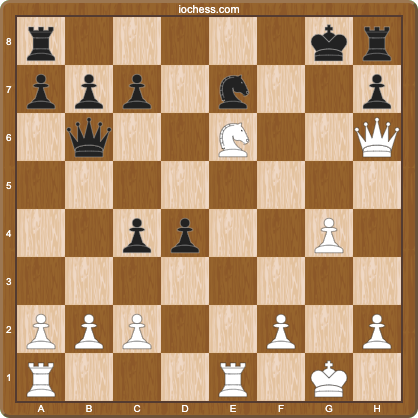
Najdorf's Calculation-Focused Approach
Najdorf, like Alekhine, tried to finish games instead of neutralizing them early. He called his exhibitions an acrobatic trick of memory: for the 42 games he had initially planned, he reckoned he would have to track 1,344 pieces, 3,688 squares, and reconstruct at least 1,680 moves (figures recounted in ChessBase's history of the record).
The approach demanded deep, continuous calculation. His 1947 display ran 23 hours 25 minutes. He reported three sleepless nights afterward, a cost others echoed even after 10 to 15 blindfold games. The debate over whether this kind of cognitive load is harmful is covered in what science actually says about blindfold chess safety.
The Rivalry and Controversy

Professional tension was real. Koltanowski questioned Najdorf's record, alleging access to scoresheets and multiple opponents per board, and said he could have played 100 games under those terms. Specialists generally rate Najdorf stronger in both standard and blindfold play, and his 1947 opposition was likely tougher.
In the standard reference Blindfold Chess, Eliot Hearst and John Knott note Koltanowski's high draw rate, 29 percent, including nine draws in under 20 moves, versus Najdorf's 9 percent with none so short. Koltanowski admitted a draw was as good as a win when many boards were still running, a pragmatic way to cut cognitive load.
Training Methods and Philosophy
Koltanowski's Systematic Approach
Koltanowski taught board geometry first: know the four quadrants, learn every square's color, and master knight routes that cover the board. Students reported that once one quadrant clicked, the rest followed the same logic.
He also claimed a phonographic memory for sequences, which helped him start on any square and complete Knight's Tours by routine. To build similar skills, work through our square colors training drill and move to coordinate training before adding speed and multiple boards.
Najdorf's Elite Performance Model
Najdorf's path relied on elite chess strength. Chess historians note that, aside from Koltanowski, the best blindfold simul players were world-class competitors such as Pillsbury, Alekhine, and Réti, which fits Najdorf's top-five status around the 1948 World Championship cycle.
Some accounts suggest Najdorf picked up blindfold techniques from the player Meir Rauch in Argentina, though chess historians treat the story with caution. Either way, he was soon considering dozens of plans per game without sight of the board.
Pros and Cons
Koltanowski Pros
Teachable Method: Sequential move repetition and patterns are learnable by club players.
Reduced Mental Strain: Early draws and mnemonics kept events manageable.
Versatile Showmanship: Knight's Tours and memory tricks drew crowds and sponsors.
Longevity: Set a 56-game consecutive record in 1960 at age 57.
Accessibility: Emphasizes memory skills over elite calculation.
Koltanowski Cons
Lower Win Rate: 70.6 percent in the 34-board record.
Quick Draws: Frequent early draws lowered competitive difficulty.
Weaker Opposition: Faced mostly club players in exhibitions.
Record Disputes: Criticizing rivals hurt his standing with experts.
Najdorf Pros
Superior Results: 86.6 percent in the 45-board record, only 9 percent draws.
Competitive Integrity: Sought clear conclusions, not convenient splits.
World-Class Strength: Managed stronger opposition effectively.
Deep Calculation: Skills transfer directly to tournament play.
Endurance: Maintained accuracy for nearly 24 hours.
Najdorf Cons
Physical Cost: Severe fatigue, including days of lost sleep.
High Barrier: Works best with master-level strength.
Less Teachable: Depends more on innate depth than drills.
Limited Accessibility: Hard for average players to replicate.
When to Choose Each Method
Choose Koltanowski's Method If...
You're an intermediate player (1200-1800 rating) seeking blindfold skills without master strength. His path of learning square colors, mapping quadrants, and move repetition gives a clear start.
You want to perform entertaining exhibitions for clubs or schools. Knight's Tours and memory feats suit instructional events and mixed-ability crowds.
You prioritize sustainability and plan frequent shows. Early draws and structured recall keep mental load stable across many boards. Our article on five mindset shifts for successful blindfold chess explains the psychology behind this approach.
Choose Najdorf's Method If...
You're already a strong player (2000+ rating) with solid calculation. His approach builds on existing tactical skill and positional feel.
You're chasing peak performance and care most about results. Playing to decisive conclusions maximizes learning and rating impact.
You can handle short bursts of extreme strain for records or special events. Expect heavy recovery needs afterward.
Modern Applications and Training
Past champions linked blindfold work to growth. Richard Réti argued that learning blindfold methods sharpened over-the-board understanding. Grandmaster Larry Christiansen said complex OTB calculation felt easier after running blindfold sets. Psychologist Nikolai Krogius credited blindfold practice with improving flexible thinking and attention control. Today's elite still trains this way, as Magnus Carlsen's blindfold method shows.
Start with foundation drills in our 7-step beginner journey, then use Dark Squares' progressive training exercises to scale difficulty. For the history-wide view, our roundup of blindfold chess world records sets benchmarks, and the core pillar on chess visualization training ties the Koltanowski and Najdorf methods to modern cognitive science.
Final Verdict
Koltanowski and Najdorf proved that blindfold mastery can follow two paths: trained memory plus structure, or elite calculation plus endurance. Their records, methods, and outcomes show clear trade-offs that modern players can exploit.
Koltanowski managed load with move repetition, mnemonics, and strategic early draws.
Najdorf relied on direct visualization, deep calculation, and played games to completion.
Results reflected approach: 70.6 percent vs 86.6 percent, and 29 percent vs 9 percent draws.
Training takeaway: build board geometry first, then add heavy calculation as strength rises.
Expect costs: memory methods scale better for frequent shows, calculation methods strain recovery.
Micro-action: This week, run 5 minutes of coordinates and knight routes daily, then play one 10-minute blindfold mini-game. Track blunders and recovery time.
For a deeper plan, see our guide to enhancing chess visualization skills and the 9 essential blindfold exercises for every level.
Sources: George Koltanowski (Wikipedia), Miguel Najdorf (Wikipedia), Chess Scotland: Koltanowski's 1937 Edinburgh blindfold record, Guinness World Records, and Eliot Hearst & John Knott, Blindfold Chess: History, Psychology, Techniques, Champions, World Records, and Important Games (McFarland, 2009).
Frequently Asked Questions
Who holds the blindfold chess world record today?
German master Marc Lang, who played 46 simultaneous blindfold games in 2011, surpassing Najdorf's 45-board mark from 1947. Najdorf's record had stood as the benchmark for decades before Lang broke it.
How many blindfold games did Alekhine play?
Alexander Alekhine reached 32 simultaneous blindfold games (Chicago, 1933). That was the record Koltanowski broke with 34 boards in Edinburgh in 1937, before Najdorf passed both with 45 boards in 1947.
Is blindfold chess bad for your brain?
There is no evidence that normal blindfold practice harms a healthy player. Historical record attempts caused short-term exhaustion and insomnia (Najdorf reported days without sleep), but that reflects extreme one-off feats, not routine training.
Can a club player learn to play blindfold chess?
Yes. Koltanowski's whole point was that the skill is teachable, not innate. Start with square colors and coordinates, then short piece-path drills, then full games on small material. You do not need master strength to play blindfold, only a reliable mental board.
Last updated
Related Articles
Magnus Carlsen and Blindfold Chess: How the Champion Trains Without the Board
Magnus Carlsen and blindfold chess go beyond a stunt. In New York in 2015 he tracked three boards with clocks, and in Vienna he faced five opponents w…
Antoine · 8 min read

How to Choose a Blindfold Chess Trainer: Features That Actually Matter
Disclosure: Dark Squares is our product. We have aimed for a fair comparison, but readers should weigh our perspective accordingly. Blindfold training…
Antoine · 7 min read

10 Classic Drills Masters Use to Train Blindfold Visualization
Blindfold chess is not magic. Miguel Najdorf played a 45-board blindfold simul in São Paulo in 1947, and George Koltanowski set a 56-game consecutive…
Antoine · 7 min read